17 Halloween Door Decorations Classroom Ideas to Try
A classroom door has a funny amount of power in October. Students can walk past twenty perfectly normal doors without noticing them, then stop dead because one has suddenly become a giant monster.
That’s what makes Halloween door decorations classroom projects so much fun. You’re working with one flat, everyday surface, yet a little paper, color, and clever composition can completely change how the hallway feels.
The best designs don’t need expensive craft supplies or hours of tiny cutting. In fact, oversized graphics, readable phrases, student-made pieces, and one strong central idea usually create more impact than dozens of unrelated decorations. Classroom displays can also incorporate student names or work, turning seasonal decor into something that feels like it belongs to the whole class.
One practical note before you start: follow your school’s rules for door decorations. Keep handles, latches, windows where required, and exit routes unobstructed, and keep decorative materials away from heat sources.
1. Giant Mummy Classroom Door
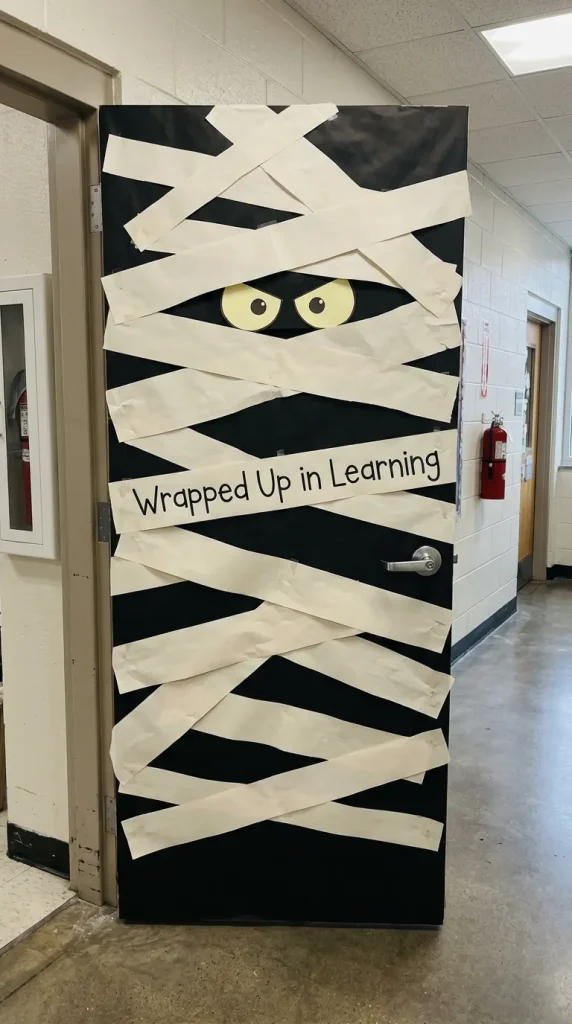
This one gets maximum visual impact from ridiculously simple materials.
Cover the classroom door with black paper first. Then run irregular strips of white bulletin-board paper diagonally across it, overlapping them like mummy bandages. Leave a dark horizontal opening near the upper third and add two oversized yellow or white eyes.
Don’t make the strips perfectly parallel. Uneven wrapping makes the mummy much more convincing, and it also means you don’t have to measure everything—which, frankly, is a gift.
You could add “Wrapped Up in Learning” across one band for a school-friendly phrase.
Keep paper clear of the handle, door edges, and any required viewing panel.
A few things you might like
- Removable mounting tape: Holds lightweight pieces without requiring permanent adhesive.
- Paper cutter: Makes preparing long paper strips much quicker.
- Large circle punch: Helps create clean eye shapes and smaller accents.
2. Our Little Pumpkin Patch Door
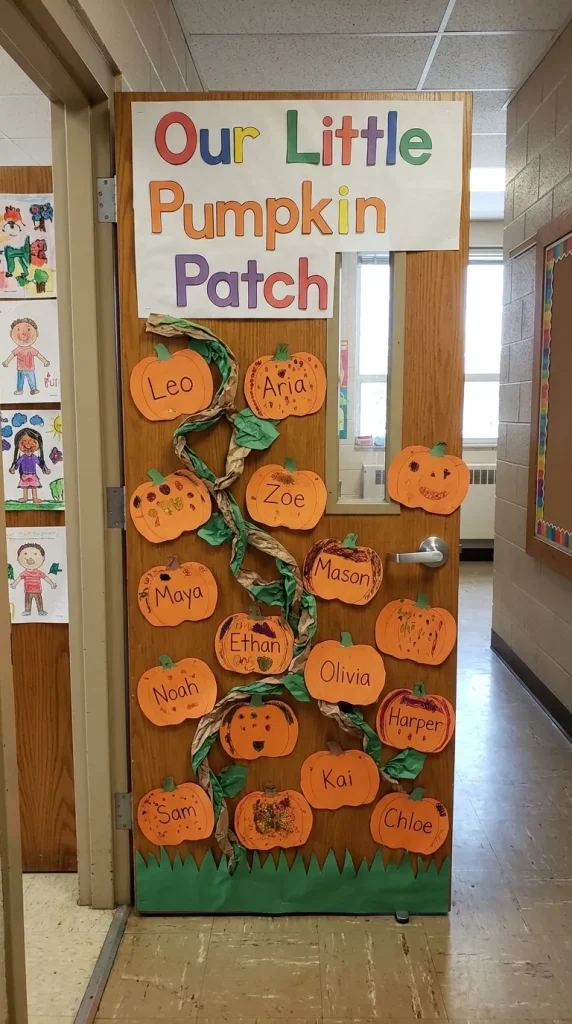
For younger students, a pumpkin patch feels festive without becoming frightening.
Create green grass along the bottom quarter of the door, then add a twisting paper vine. Each student decorates a different paper pumpkin and adds their name.
That student-made element is worth keeping. Current classroom Halloween displays commonly use personalized pumpkins, ghosts, monsters, and photo pieces to make every child part of the finished design.
Put a large “Our Little Pumpkin Patch” sign above the display and keep the background fairly plain. The individual pumpkins already provide plenty of color.
Give these a look
- Orange cardstock pack: Gives student pumpkins more structure than thin copy paper.
- Leaf-shaped craft punch: Quickly produces small vine details.
- Black paint markers: Make names and faces easy to read from the hallway.
3. Monster Mouth Entrance
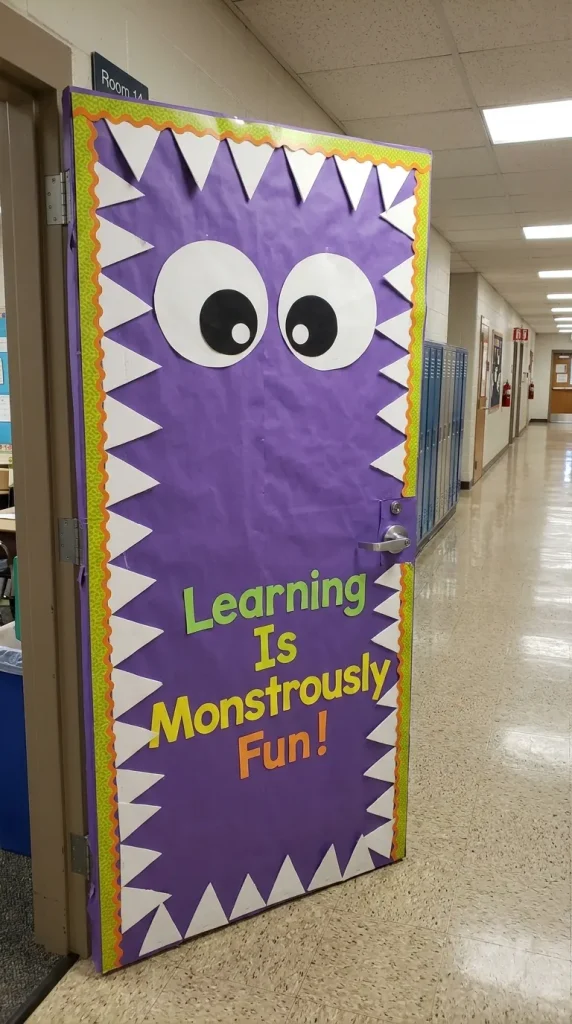
Here, the entire doorway becomes the monster.
Cover the door in purple, green, or blue paper. Add enormous eyes near the top and triangular white teeth around the sides, positioning the actual doorway as though students are walking into the creature’s mouth.
A phrase such as “Learning Is Monstrously Fun” keeps the design connected to the classroom.
This works especially well from a distance because there aren’t many tiny elements competing for attention.
Worth considering
- Bulletin board paper roll: Covers a large surface with fewer seams.
- Removable adhesive dots: Make positioning lightweight teeth and eyes easier.
- Decorative border roll: Creates a clean outer edge without adding clutter.
4. Spooky Readers Haunted Library Door
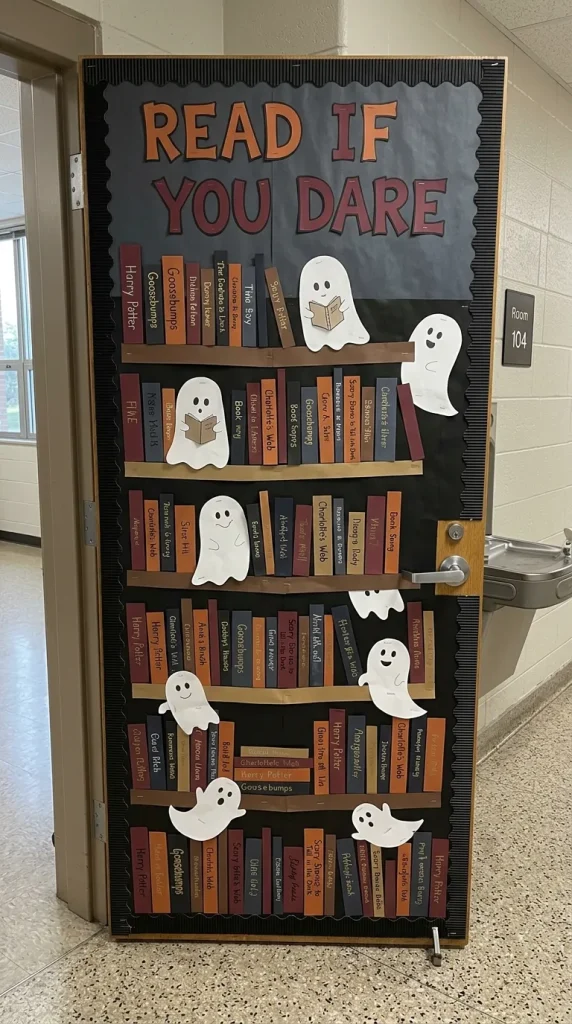
A Halloween classroom door can actually reinforce what happens inside the room.
Turn the door into a dark little library scene. Make crooked paper bookshelves, add friendly ghosts reading books, and use the phrase “Read If You Dare.” Halloween classroom resources currently use reading ghosts, bats, pumpkins, and book stacks to connect seasonal decorating with literacy.
Students could write their favorite spooky, mysterious, or autumn-themed book title on individual paper books.
For elementary classes, keep the ghosts cheerful. Middle-school teachers can shift toward black, charcoal, burgundy, and burnt orange for a less cartoonish look.
Possibly handy products
- Metallic paint pens: Add readable book titles against dark paper.
- Book-shaped sticky notes: Let students add recommendations throughout October.
- Black bulletin-board border: Frames the display and strengthens the library atmosphere.
5. Friendly Ghost Class Portrait Door
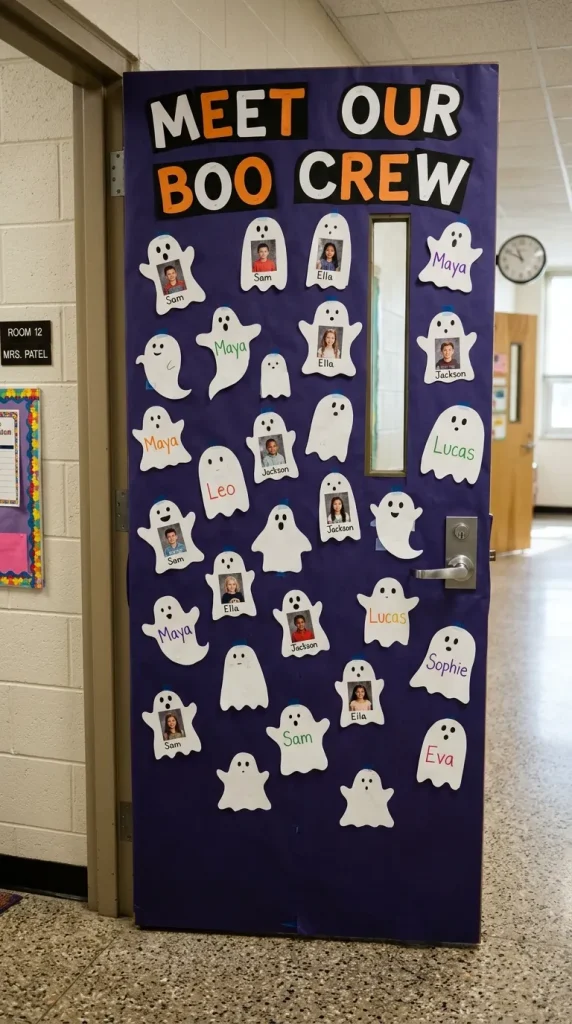
Instead of decorating for your students, make the students the decoration.
Create one white paper ghost for every child. Place a student photo or handwritten name in the center, then arrange the ghosts floating across a dark purple or black background.
Current classroom door sets use this exact personalization principle because individual photo or name spaces can turn Halloween decor into a class-community display.
Add “Meet Our Boo Crew” across the top.
The visual trick is varying the ghost positions rather than placing them in rigid rows. It makes the whole door feel lively while keeping every student equally represented.
A few suggestions
- Photo-safe adhesive squares: Attach printed photographs without messy liquid glue.
- White cardstock: Keeps ghost silhouettes crisp instead of floppy.
- Letter stencil set: Creates a clean headline without needing a cutting machine.
6. Hocus Pocus Science Lab Door
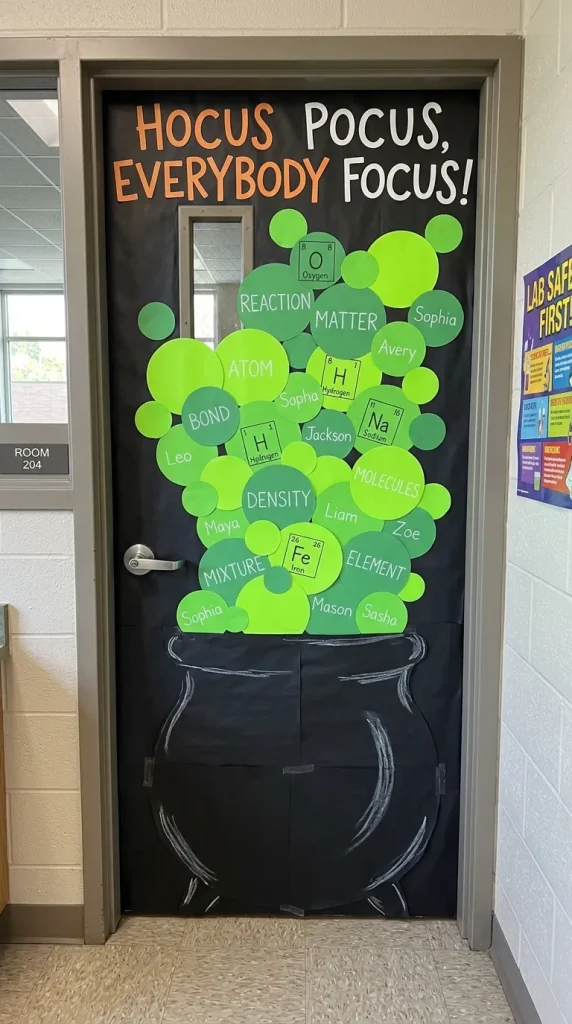
Science teachers, this one practically writes itself.
Turn the bottom of the door into a huge black cauldron. Let fluorescent green paper bubbles rise upward, and write vocabulary terms, formulas, scientific questions, or student names inside them.
Across the top: “Hocus Pocus, Everybody Focus.” The phrase already appears in current classroom Halloween decor, often paired with cauldrons, bats, and seasonal classroom graphics.
For extra subject relevance, label a few bubbles with elements from the periodic table or concepts students are currently studying.
Now the decoration feels intentionally connected to class instead of borrowed from a party aisle.
Maybe worth checking out
- Neon cardstock: Makes potion bubbles pop against a dark background.
- White chalk markers: Create a laboratory-board effect on black paper.
- Circle cutter: Speeds up making bubbles in several sizes.
7. Giant Jack-O’-Lantern Door
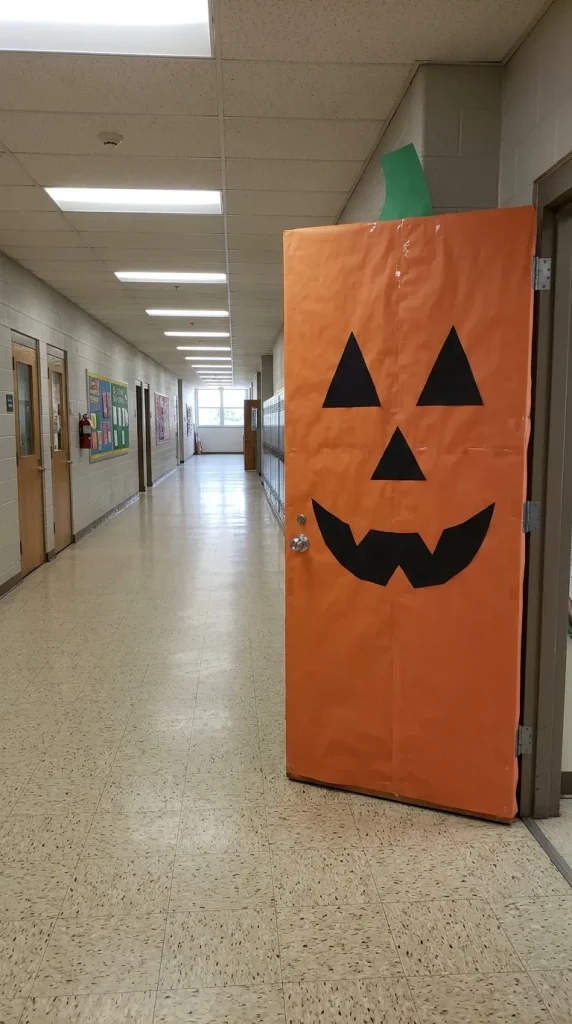
If you need something that can go up quickly, simplicity wins.
Cover most of the door in orange paper. Add enormous black triangle eyes, a nose, and a wide jack-o’-lantern mouth. Halloween door decorating guides use the same full-door pumpkin approach because the door itself naturally provides the rectangular canvas.
Add a green paper stem above the door if your school allows decorations around the frame.
The beauty here is scale. Three large facial features create more hallway impact than thirty tiny pumpkins.
IMO, this is one of the best choices when you have limited prep time.
Useful items to consider
- Wide orange paper roll: Minimizes seams across the background.
- Large cutting mat: Makes oversized facial shapes easier to trim cleanly.
- Low-tack painter’s tape: Helps temporarily position pieces before final attachment.
8. Creepy-Crawly Spiderweb Math Door
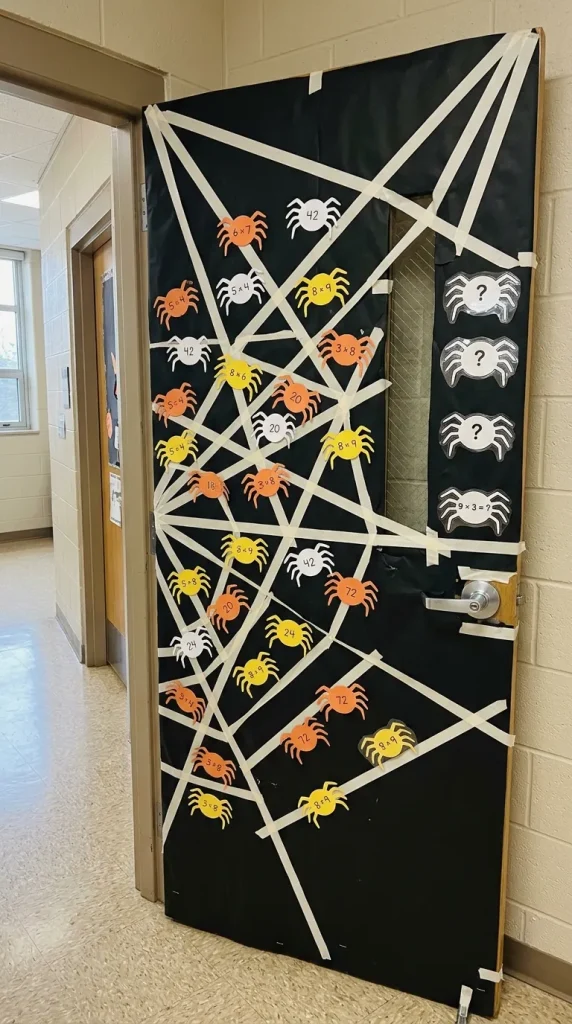
Start with a giant web stretching diagonally across a black or dark gray door.
Then make each spider part of a math challenge. One might show “6 × 7,” while another carries “42.” Younger classes could match numbers to quantities; older students could use fractions, equations, or geometry terms.
The design still reads instantly as Halloween, but the closer students look, the more they discover.
Use thick white lines for the web rather than fuzzy synthetic cobweb material. Flat paper or tape creates a cleaner classroom display and is easier to control around a working doorway.
Helpful additions
- White removable graphic tape: Produces crisp web lines without drawing each one.
- Spider-shaped paper punch: Makes repeated student pieces quickly.
- Laminating pouches: Let you reuse question spiders in future lessons.
9. Haunted House Classroom Door
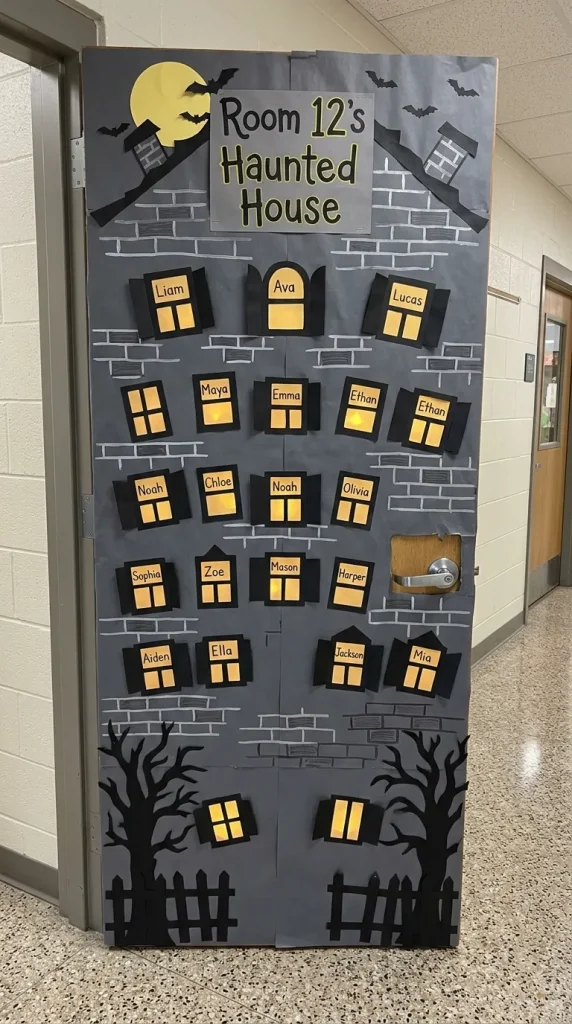
This is the design for teachers who want a little more drama.
Transform the whole door into the front of a haunted mansion using gray or black paper. Add crooked windows, shutters, a moon, bats, and glowing yellow window shapes.
Haunted pathways and houses remain popular classroom-door formats because they turn the rectangular doorway into one complete scene rather than a collection of separate decorations.
Put each student’s name inside a different window. Suddenly the haunted mansion becomes “Room 12’s Haunted House” rather than generic Halloween scenery.
Skip excessive 3D pieces around the handle and opening edge. A layered flat-paper design can still look detailed without interfering with the door.
Nice finishing touches
- Silver marker set: Adds cracks, bricks, and architectural lines to dark paper.
- Precision craft scissors: Help with crooked window and roof silhouettes.
- Yellow translucent paper: Gives windows a convincing illuminated appearance without electrical lights.
10. Bat Cave Learning Door
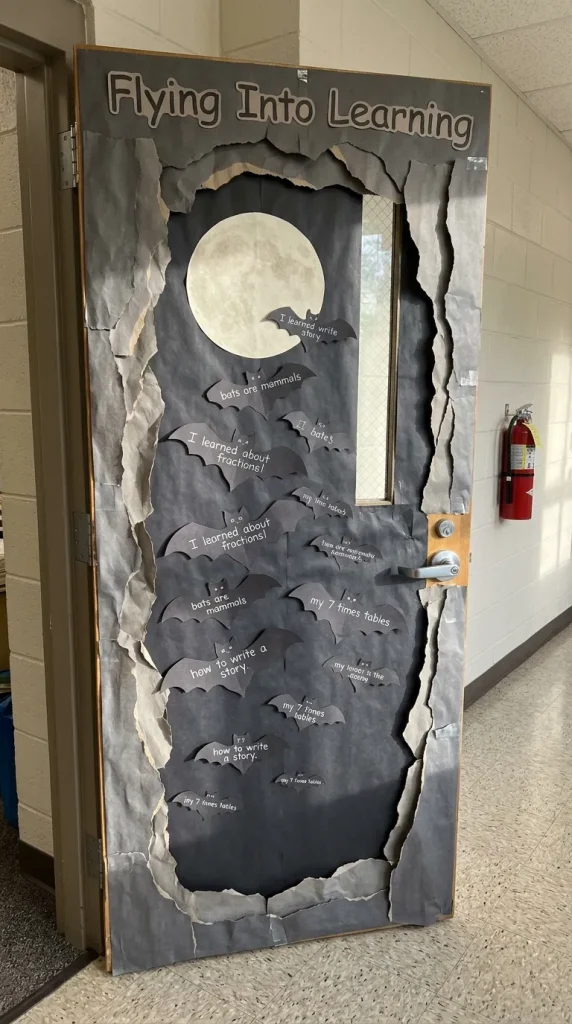
This concept works particularly well for older elementary or middle-school classrooms.
Cover the door in charcoal paper and create a cave opening using torn gray paper around the edges. Fill the center with bats flying upward toward a large moon.
Instead of giving every bat the same appearance, let students design their own silhouette or write something they’ve learned that month on it.
A simple headline such as “Flying Into Learning” keeps the classroom connection clear.
Use bats in three noticeably different sizes. That little perspective trick creates depth without requiring elaborate 3D construction.
Practical extras
- Bat craft punch: Saves serious time if you need dozens of small silhouettes.
- Gray kraft paper: Tears naturally into convincing rocky cave edges.
- White gel pens: Let students write clearly on black bat shapes.
11. Skeleton Anatomy Classroom Door
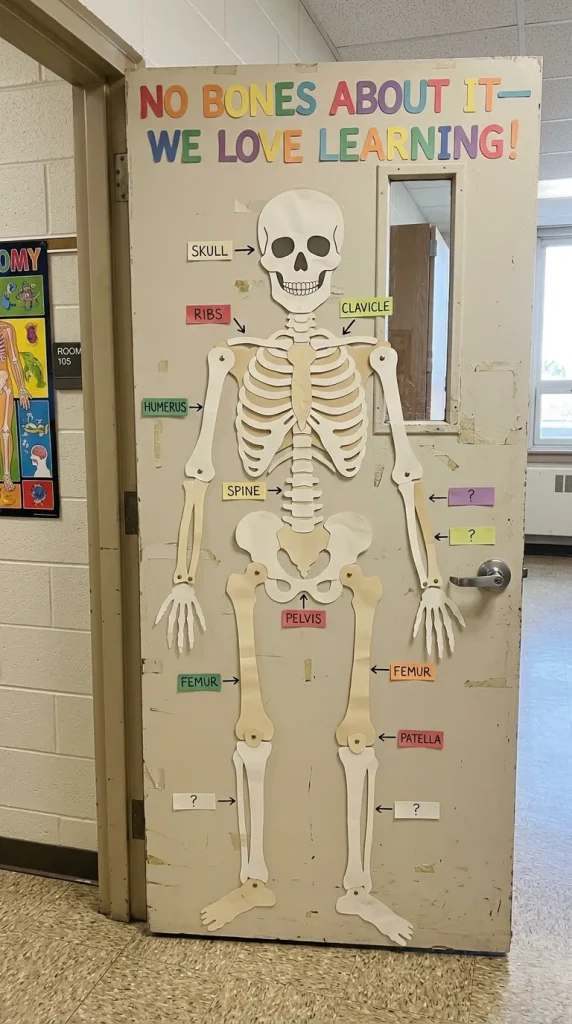
A skeleton doesn’t have to be creepy. It can be surprisingly useful.
Create a large paper skeleton across the door, then label major bones according to your students’ grade level. For younger children, keep it simple: skull, ribs, spine, pelvis, arms, and legs.
For older students, turn the door into an anatomy challenge and leave selected labels blank.
The Halloween connection happens naturally, while the educational layer gives the decoration a reason to stay up beyond a classroom party.
Add “No Bones About It—We Love Learning” at the top for a little teacher-level wordplay.
A few relevant products
- Human anatomy poster: Helps you position major bones more accurately while creating the display.
- Removable label stickers: Make interactive identification activities possible.
- Fine-tip black markers: Add clean anatomical labels without overwhelming the illustration.
12. Witch’s Spell Book Door
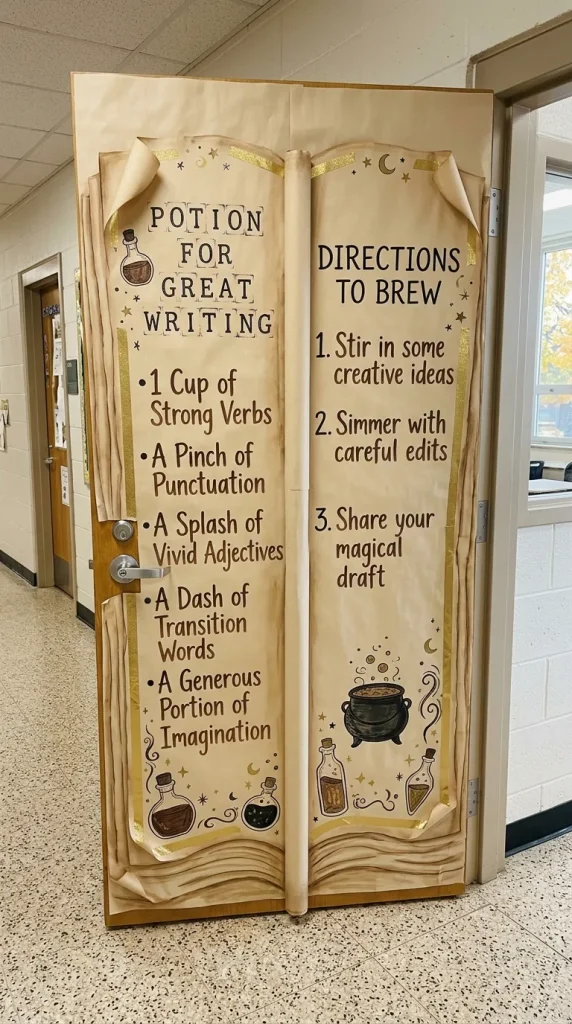
Instead of the usual witch silhouette, turn the entire door into an oversized open spell book.
Use tan or parchment-colored paper as the base. Draw slightly curled page edges, then divide the surface visually into two giant pages.
Here’s where it gets fun: replace spells with classroom content. “Potion for Great Writing” could contain ingredients such as strong verbs, details, punctuation, and revision. A math classroom could create a “Formula Book of Mysteries.”
Add small stars, moons, bottles, and a black cat around the page edges rather than covering every available inch.
Possibly helpful picks
- Brown brush markers: Create convincing aged-page shading.
- Alphabet stamp set: Gives headings an old-book appearance.
- Gold washi tape: Adds small decorative details without needing glitter.
13. Candy Corn Kindness Door
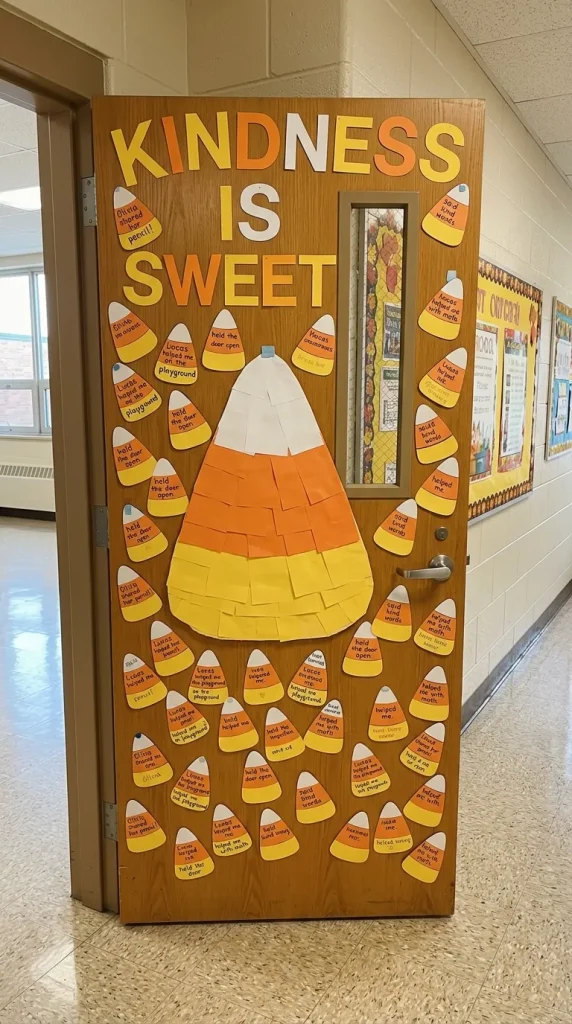
Not every Halloween classroom decoration needs to be spooky.
Create one oversized candy corn in the center using white, orange, and yellow paper. Around it, place smaller candy corn pieces containing acts of kindness students have noticed in the classroom.
The display grows during October as more pieces get added.
This concept works because the seasonal graphic stays simple while the student contributions become the interesting part. It also gives you an easy alternative if your school or younger students prefer cheerful Halloween decor over ghosts and skeletons.
Use the phrase “Kindness Is Sweet” rather than packing the door with additional Halloween sayings.
A few favorites
- Three-color cardstock bundle: Keeps the candy-corn palette consistent.
- Fine-tip permanent markers: Give students enough room to write on smaller pieces.
- Wall-safe adhesive putty: Makes adding new kindness pieces throughout the month easy.
14. Graveyard of Great Ideas Door
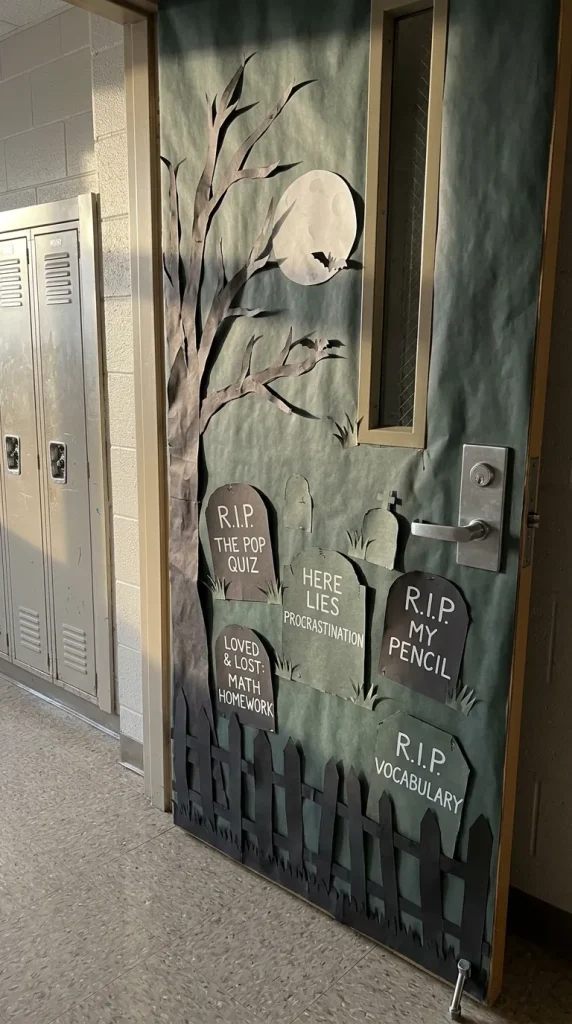
For older students, a graveyard theme can look clever rather than gruesome.
Cover the lower half of the door with dark green or gray paper and add tombstone silhouettes. Each tombstone contains a funny academic phrase, vocabulary term, historical figure, book title, or concept related to your subject.
A Halloween classroom decorating source similarly suggests a learning-themed graveyard concept, showing how the classic Halloween scene can translate naturally to a school door.
Keep the artwork stylized rather than realistic. A crooked fence, moon, bare tree, and five or six tombstones create enough atmosphere.
Helpful accessories
- Gray cardstock: Gives tombstones enough contrast against a dark background.
- White paint pen: Creates convincing engraved-looking lettering.
- Decorative-edge scissors: Add irregular edges to landscape pieces without detailed cutting.
15. Frightfully Bright Future Door
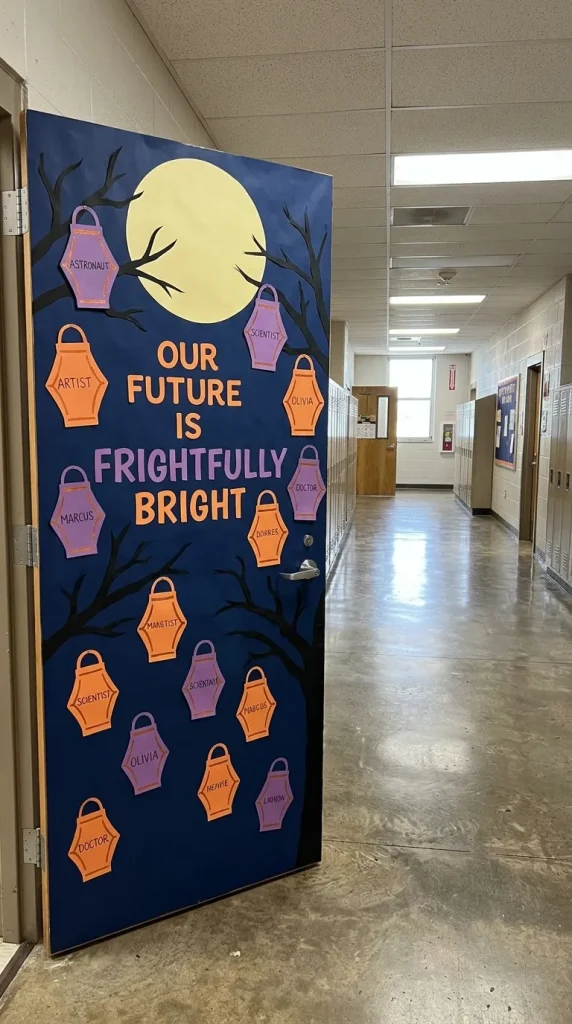
Middle and high school students don’t always want cute smiling pumpkins staring at them every morning.
Go darker and cleaner instead.
Use a deep navy or black background, one oversized moon, silhouettes of bare branches, and glowing orange or purple paper lanterns. Write each student’s name—or a future goal—inside a lantern.
The “Our Future Is Frightfully Bright” concept currently appears in Halloween classroom decor aimed specifically at middle and high school settings, using lanterns and darker seasonal colors rather than juvenile characters.
Leave negative space around the headline. A mature classroom door usually looks stronger when you resist filling every gap.
A few designer picks
- Metallic orange markers: Give lantern details a subtle glow against dark paper.
- Navy bulletin paper: Creates a softer backdrop than pure black.
- Moon stencil: Helps produce one crisp oversized focal point.
16. Black Cat Peeking Through the Door
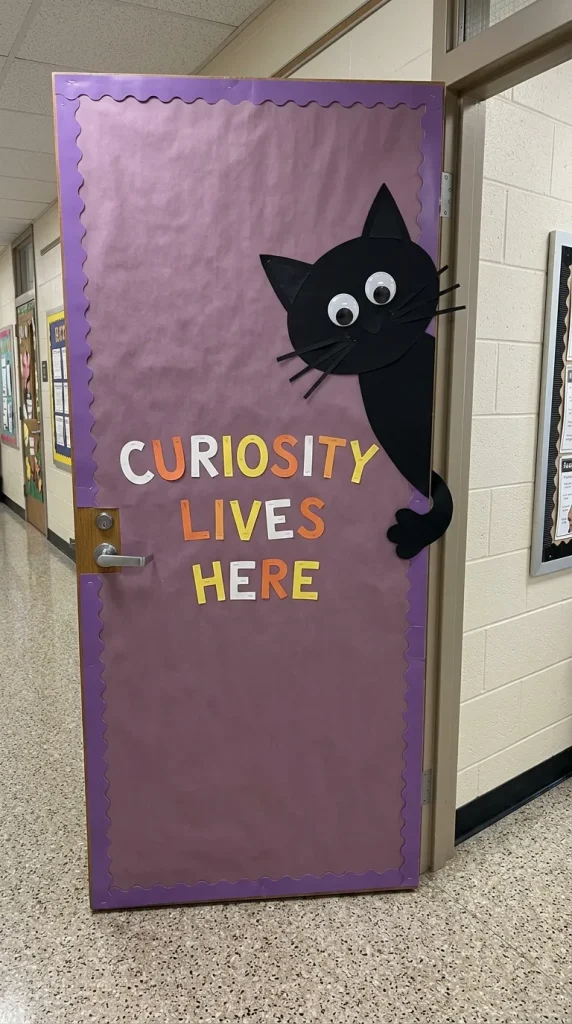
Sometimes one giant character beats an entire Halloween landscape.
Cover the door with a muted purple background and create an oversized black cat appearing to peek around one side. Make the face enormous—bright eyes, pointed ears, whiskers, and one paw curling around the edge visually.
Across the open side, add “Curiosity Lives Here.”
That wording makes the cat theme surprisingly appropriate for science, library, or general elementary classrooms.
FYI, keep the cat itself mostly black rather than adding dozens of patterns. The recognizable silhouette and bright eyes provide the contrast.
Some ideas to consider
- Black poster board: Produces a richer, more solid silhouette than thin construction paper.
- Large googly eyes: Add movement and humor if your school permits raised decorations.
- Purple border trim: Finishes the background without introducing another competing theme.
17. Halloween Classroom Door Made From Student Self-Portraits
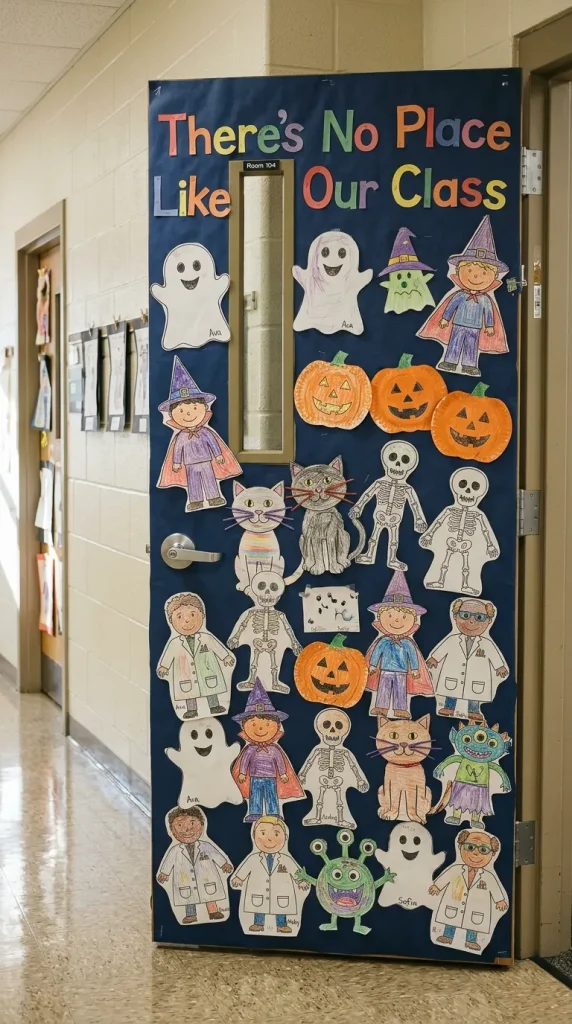
For the final idea, let the class create almost everything.
Give each student a simple paper portrait template and ask them to transform themselves into a friendly Halloween character—a wizard, ghost, pumpkin, cat, skeleton, scientist, or imaginative monster.
Arrange the finished portraits across the door beneath “There’s No Place Like Our Class.”
The result will never look perfectly coordinated, and that’s exactly why it works. Student-created classroom displays naturally produce variation in color, expression, and style that pre-made decorations can’t replicate. Classroom door inspiration also regularly incorporates individualized student pieces to build a sense of class identity.
For younger grades, provide pre-cut shapes. Older students can design theirs from scratch.
A few complementary pieces
- Skin-tone marker set: Gives students more choices when creating self-portraits.
- Heavy mixed-media paper: Handles markers, crayons, and glued details better than copy paper.
- Display clips: Make it easier to remove portraits later and return the artwork to students.
The best Halloween door decorations classroom ideas don’t necessarily come from using the most supplies. They come from choosing one concept that students can recognize from the other end of the hallway.
A giant mummy does that. So does a monster mouth, haunted library, glowing lantern scene, pumpkin patch, or enormous black cat.
I especially like designs that give students a role. A pumpkin with their name, a bat carrying something they learned, a kindness candy corn, a haunted-house window, or a Halloween self-portrait turns the door from the teacher’s decoration into the class’s display.
And you really don’t need to make it complicated. Large shapes are easier to cut, easier to see, and usually quicker to install. Keep functional parts of the doorway clear and follow your school’s fire and decoration policies; safety guidance emphasizes unobstructed exits and keeping decorations away from ignition sources.
Choose the idea that suits your students’ age and your subject, then make that one concept memorable. A classroom door doesn’t need fifty decorations to get fifty hallway smiles.

William Martin is a passionate bowler who spends most of his weekends playing the sport. With years of intense experience under his belt, William decided to share his knowledge by creating BOWLING OCEAN. Join me on this journey to explore the world of bowling and discover the tips and tricks to becoming a pro.