17 Fall Hanging Basket Ideas That Feel Fresh, Full, and Intentional
A hanging basket can do much more in fall than hold a few flowers above the porch. It can frame an entrance, turn an empty balcony corner into a garden moment, create a useful herb station, or add height where the rest of the landscape feels flat.
The trick is to stop treating every basket as the same container with different flowers inside it.
Fall gives you plenty of options beyond the usual flower-filled basket. Cool-season plants such as pansies, ornamental kale, snapdragons, sweet alyssum, and Swiss chard can extend container interest as temperatures drop, while grasses, foliage, trailing plants, and woody elements can provide structure after summer flowers begin to fade.
Here are 17 fall hanging basket ideas built around genuinely different ways to use the format.
1. A Three-Tier Hanging Basket for Vertical Impact
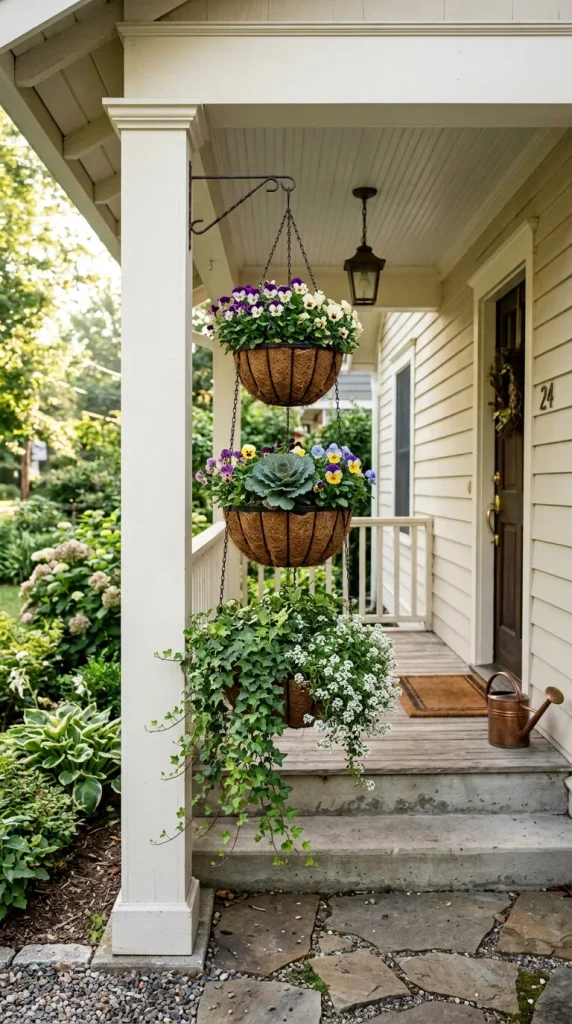
If your porch has plenty of vertical space but not much floor space, turn one hanging point into a miniature vertical garden.
Use three baskets suspended at different heights rather than trying to make one oversized basket do everything. Keep the upper basket visually simple, let the middle basket carry the main planting, and use the lowest basket for trailing foliage that can fall freely.
The staggered arrangement creates movement from top to bottom and works particularly well beside a doorway, at the end of a covered porch, or in a tall, narrow entry zone.
For the planting, think in terms of different growth habits rather than three different color combinations. A compact cool-season flowering plant can occupy one level, foliage can dominate another, and a trailing plant can soften the bottom.
Just remember that suspended containers dry quickly, especially wire baskets with porous liners, so a multi-level display needs easy access for watering.
A few things that make the setup easier
- Adjustable hanging chains let you fine-tune the height.
- Lightweight baskets make the installation safer.
- A long-spout watering can helps reach upper containers.
- Use matching basket shapes so the arrangement feels intentional.
2. A Half-Round Wall Basket for a Small Porch
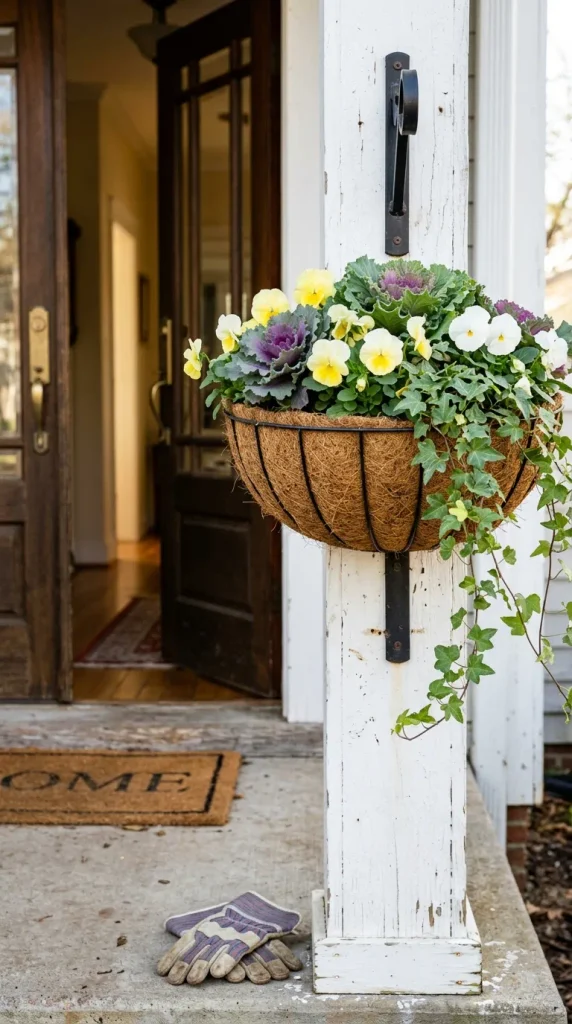
Not every hanging basket needs to hang from the ceiling.
A half-round wall basket mounted against a porch column, exterior wall, fence, or balcony railing can create the same seasonal effect while using much less space.
This is especially useful when a traditional hanging basket would interfere with people walking underneath it.
Build the planting around the viewing angle. Since the basket sits against a vertical surface, you do not need to spend planting space creating a full 360-degree composition. Instead, concentrate the strongest foliage and flowers toward the visible front.
A coir-lined wire basket can work particularly well because side planting lets you create a fuller appearance rather than relying entirely on trailing growth. Illinois Extension specifically notes that lined hanging baskets can be planted through their sides for a densely planted effect.
Useful additions
- Heavy-duty wall brackets provide better support than lightweight hooks.
- Coir liners make wire baskets easier to plant.
- A small drip tray or moisture-management liner can reduce water loss.
- Weather-resistant mounting hardware keeps the installation practical.
3. Paired Baskets Framing the Front Door
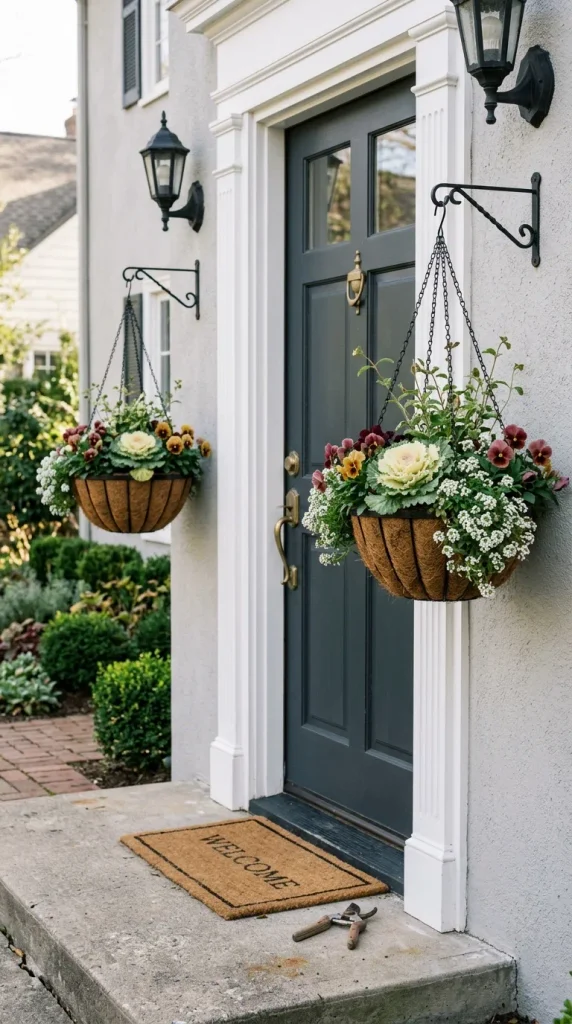
Instead of hanging one basket somewhere near the entrance, use two matching baskets to frame the doorway.
This changes the basket from a decorative accessory into part of the architecture.
Hang one on each side of the entrance at roughly the same height. The planting does not need to be identical, but the baskets should share enough structure to read as a pair.
This works especially well when the doorway itself already has strong architectural lines. The baskets soften those lines without competing with the door.
For fall, use cool-season flowers mixed with foliage rather than relying entirely on blooms. Pansies, ornamental kale, and other cool-season plants can continue providing interest as temperatures decline.
A few practical pieces worth considering
- Matching hanging baskets create visual symmetry.
- Adjustable chains help keep both baskets level.
- Outdoor-rated hooks are useful for permanent seasonal displays.
4. A Basket Built Around Ornamental Grass
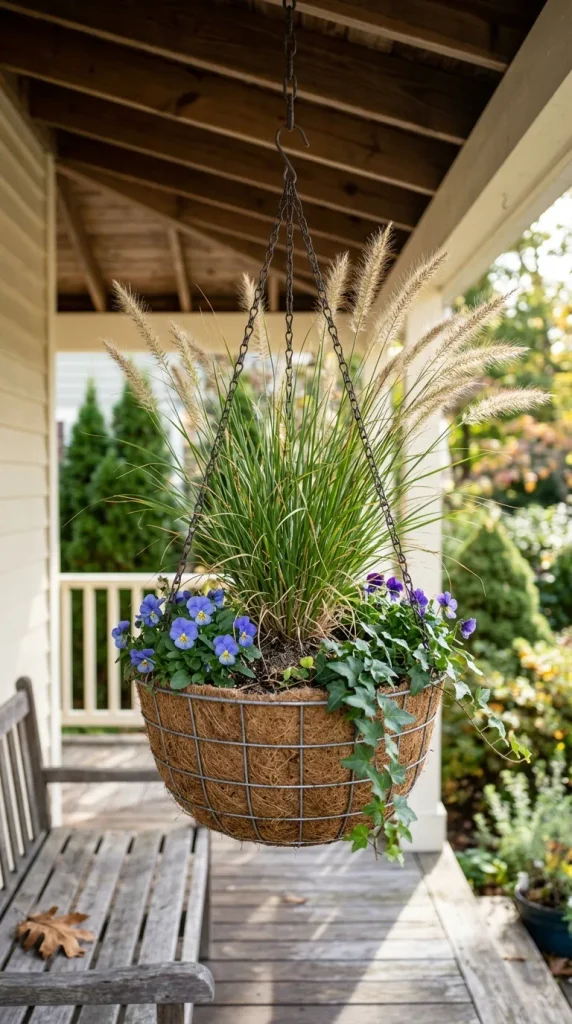
Flowers do not have to be the star.
For a more architectural fall hanging basket, make ornamental grass or grass-like foliage the main structural element and allow smaller plants to fill around it.
The movement becomes the attraction. A light breeze makes the foliage shift while the surrounding plants provide lower, denser texture.
This approach is particularly effective on open porches where the basket can move naturally rather than being tucked against a wall.
Extension guidance also recommends ornamental grasses as useful focal plants in fall containers because they continue providing structure and height when newly planted seasonal flowers remain relatively short.
Give the arrangement some support
- A lightweight but sturdy basket prevents excessive swinging.
- A strong ceiling hook matters more when the planting has height.
- A moisture-retaining liner can help reduce drying around exposed roots.
5. A Full Waterfall Basket Using Trailing Foliage
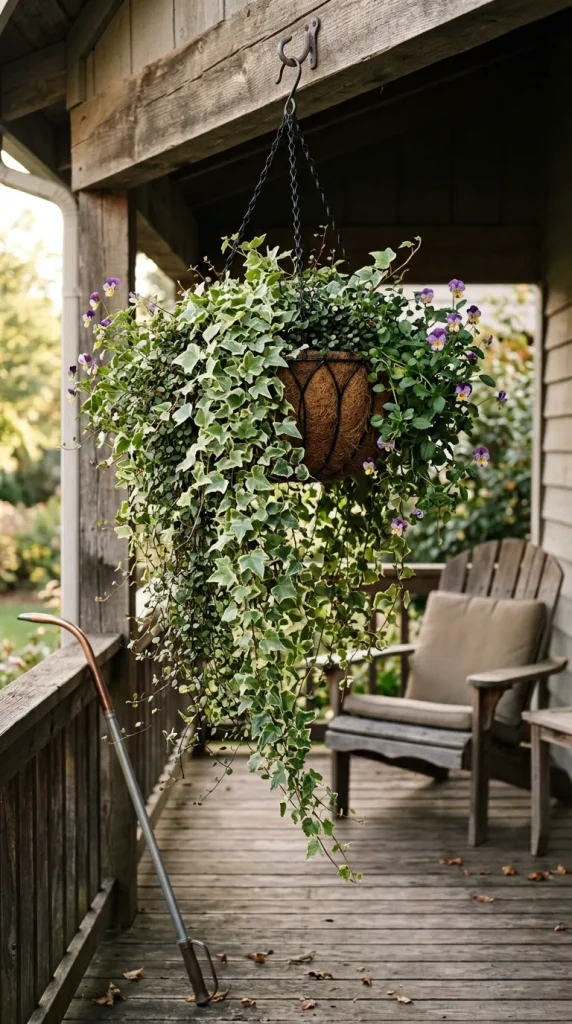
Some baskets look better when you deliberately remove the upright centerpiece.
Instead, create a basket where the visual weight begins at the rim and spills downward.
This works particularly well when the basket will be mounted above eye level. Illinois Extension recommends rounded or trailing forms for baskets positioned well above the viewer because tall center plants become less useful from that angle.
The goal is not simply “add trailing plants.” Think about the final silhouette.
You want foliage to emerge from multiple points around the rim, overlap naturally, and eventually obscure much of the container.
Helpful finishing pieces
- A pre-formed coir liner provides a clean planting surface.
- Adjustable chains let you position the basket at the right viewing height.
- A watering wand makes reaching dense trailing foliage much easier.
6. A Fall Herb Basket You Can Actually Use
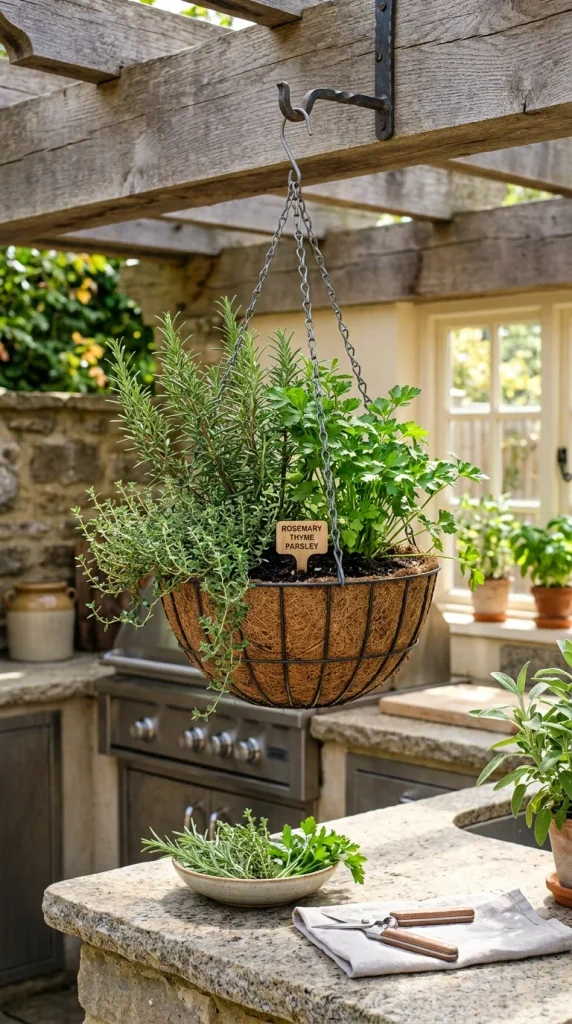
A hanging basket can be decorative and useful at the same time.
Create a small herb garden near an outdoor kitchen, back door, patio seating area, or sunny kitchen window.
Rosemary, thyme, oregano, parsley, sage, and chives are among the herbs suitable for container growing, although individual light and moisture requirements vary.
Instead of trying to squeeze every herb into one container, choose a small group with similar growing requirements.
Keep the planting accessible enough that you can actually harvest it. A beautiful herb basket hanging six feet above your head is technically a garden, but not a particularly useful one.
Practical herb-garden additions
- Weatherproof plant labels make harvesting easier.
- Small pruning scissors can stay nearby for quick harvesting.
- A sturdy hanging bracket is useful for heavier, mature herb baskets.
7. A Cool-Season Flower Basket for a Longer Display
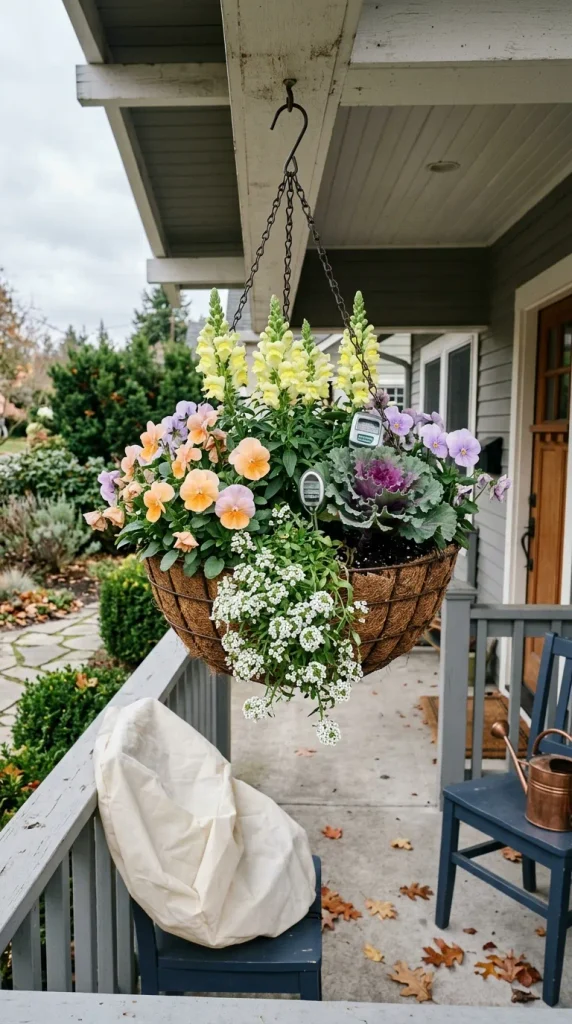
Rather than designing a basket around “fall color,” design it around fall performance.
Pansies, violas, snapdragons, sweet alyssum, ornamental kale, and other cool-season plants can help keep containers interesting after summer annuals begin to decline. Several are classified as hardy annuals with better tolerance of cool conditions.
This approach is ideal if you want the basket to look good for more than a brief autumn decorating window.
Use one plant for the main flowering presence, another for foliage texture, and something trailing to connect the planting to the basket itself.
The result feels more like a functioning seasonal garden than a temporary decoration.
Consider these useful extras
- A lightweight frost cover can protect vulnerable plants during cold nights.
- Plant markers help you remember what is planted where.
- A moisture meter can help avoid both excessive drying and overwatering.
8. An Ornamental Kale Centerpiece Basket
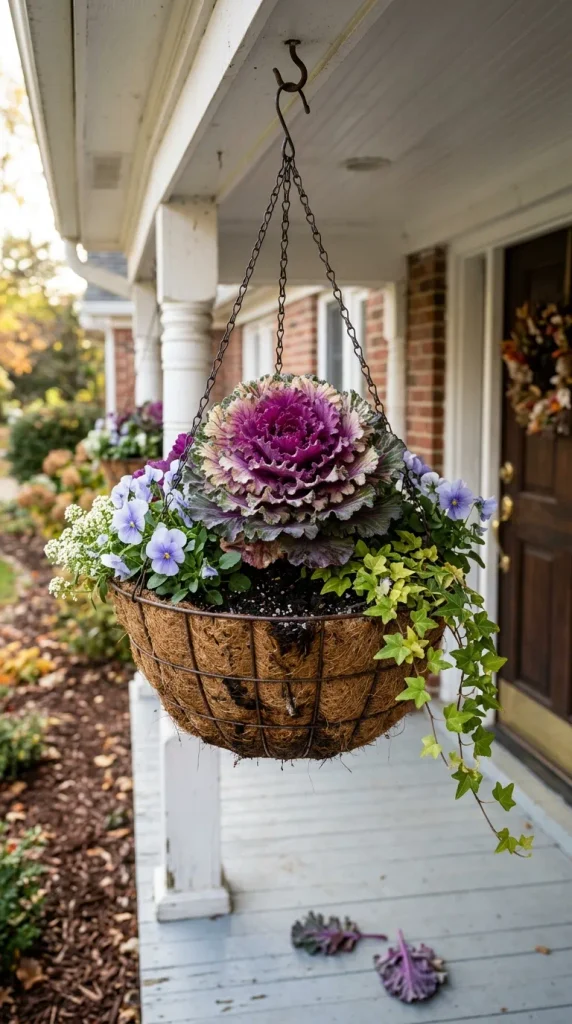
Here is a different approach: make foliage the focal point.
Ornamental kale and cabbage bring a strong rosette form that immediately gives a basket visual structure. They can also be combined with smaller flowering plants or trailing foliage rather than being treated as the entire composition.
Illinois Extension recommends ornamental kale for fall containers and notes its ability to provide interesting foliage and texture.
Place the strongest rosette slightly above the surrounding plants so it reads as the basket’s centerpiece.
This idea works especially well when you prefer a garden that still looks intentional after individual flowers begin fading.
A few useful companions
- A simple hanging basket with a strong frame gives the kale visual priority.
- A clean liner prevents exposed planting media from distracting from the foliage.
- A small hand pruner helps remove damaged outer leaves.
9. A Basket With Decorative Branches for Autumn Structure

Think beyond living flowers.
A few weathered, branching stems can create vertical structure inside a fall basket while the living plants fill the lower portion.
The branches give the arrangement height without requiring a tall flowering plant.
This can also make the basket look interesting during periods when flowering slows down. The combination of woody texture, foliage, and smaller seasonal flowers creates more visual layers than a flat mound of blooms.
Keep the branches securely anchored rather than allowing them to become loose weight at the top of the basket.
Useful materials for the build
- Floral or garden ties can secure branches discreetly.
- A sturdy basket frame handles the additional structure better.
- Small hand pruners make shaping branches easier.
10. A Hanging Basket Chandelier Over a Patio
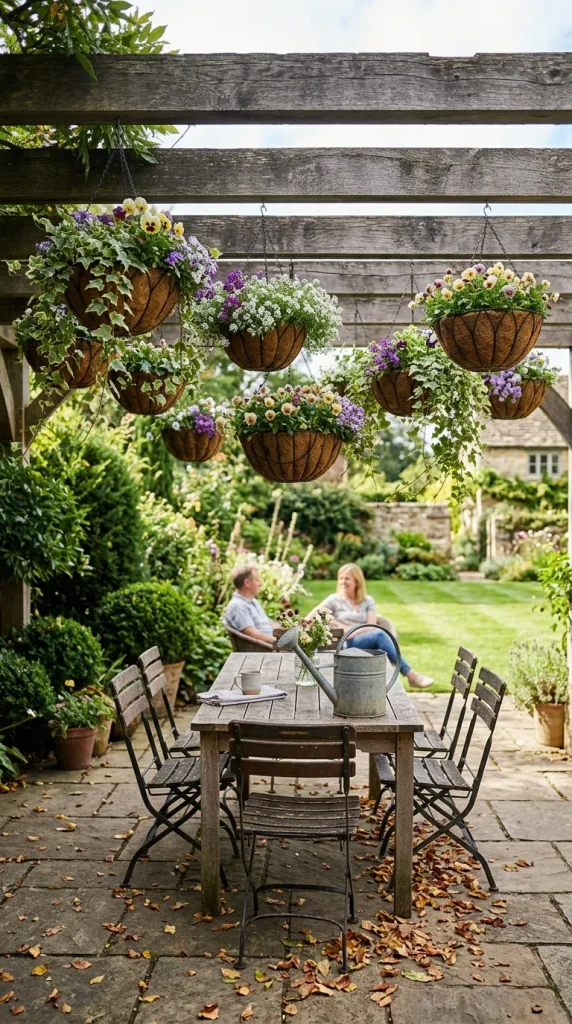
Instead of one basket, create a small overhead composition.
Several baskets can be suspended from a pergola beam, covered patio structure, or sturdy outdoor framework at slightly different heights.
The important difference here is that the group becomes the design feature.
Keep the individual baskets relatively simple. If every basket contains a completely different planting, the arrangement can become visually noisy.
Use repeated basket forms and let the variations come from growth habit, height, and texture.
This is particularly effective above a dining table or seating area because it brings greenery down into an otherwise hardscape-heavy space.
Useful setup pieces
- Multiple adjustable suspension chains make height changes easier.
- Heavy-duty outdoor hooks are essential for structural safety.
- Lightweight baskets reduce the load on overhead mounting points.
11. A Balcony-Railing Basket for Tiny Outdoor Spaces
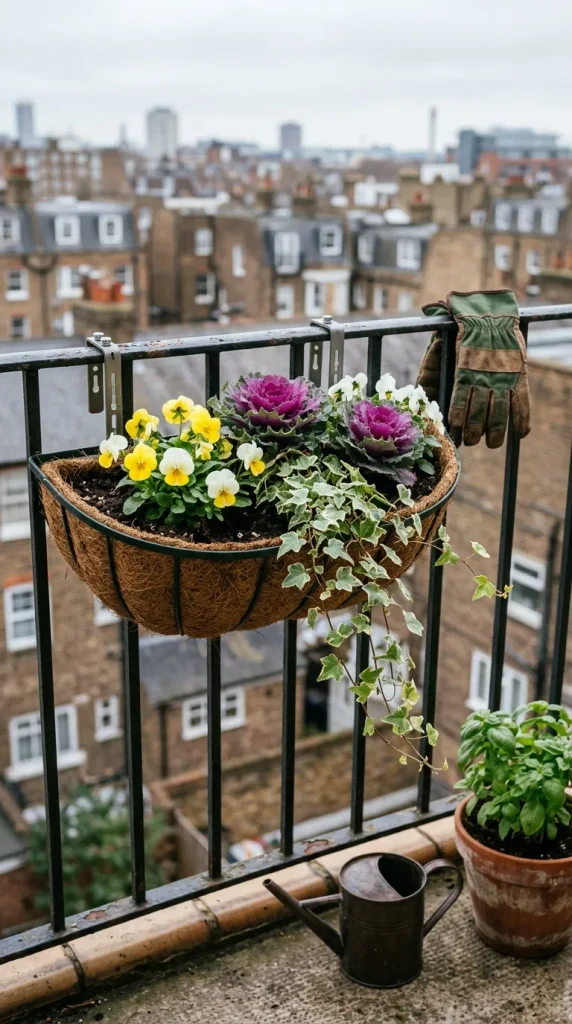
If you have a balcony but almost no floor space, move the garden to the railing.
A railing-mounted basket can give you seasonal planting without consuming valuable walking or seating space.
This is one of the more practical fall hanging basket ideas because the design begins with a spatial problem: where can the garden go when the floor is already occupied?
Use compact plants toward the top and let selected foliage or flowers soften the outer edge.
Before installing anything, check the railing’s construction and the mounting hardware’s load capacity. Waterlogged containers become considerably heavier than they appear.
Helpful balcony additions
- Adjustable railing brackets allow better positioning.
- Lightweight containers reduce structural load.
- A narrow watering can is easier to use in confined spaces.
12. A Side-Planted Basket That Looks Full From Every Angle
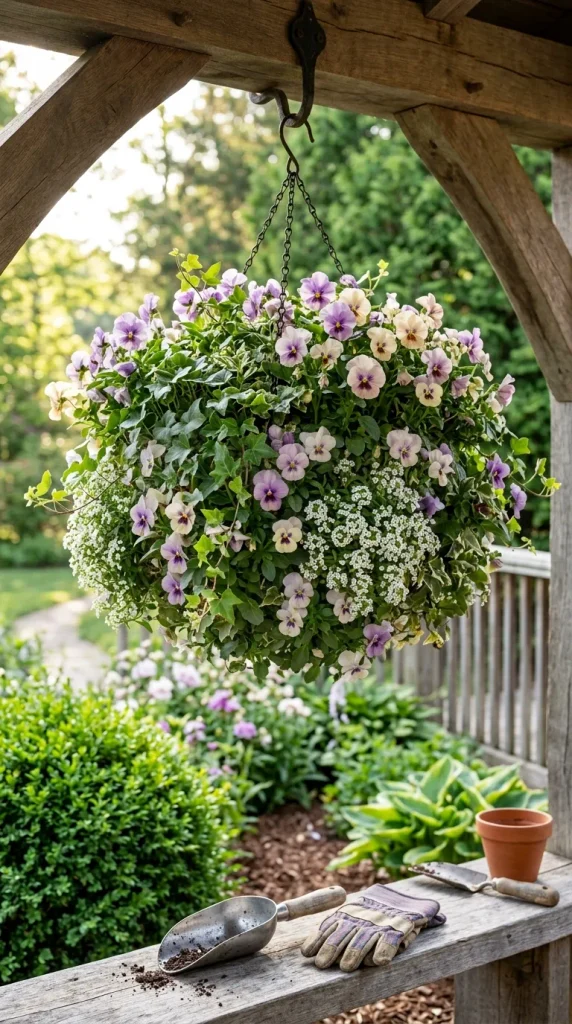
Most people plant hanging baskets from the top.
You do not have to.
With a suitable lined basket, plants can also be inserted through the sides, creating a much denser composition around the entire container. Illinois Extension describes this technique as a way to create a completely full-looking basket.
This is particularly useful when the basket can be seen from multiple directions.
Start with the lower side openings, work upward, and finish with the top planting. Choose plants that can tolerate the available light and moisture rather than simply selecting the largest number of plants possible.
The result can look almost like a living sphere suspended in the air.
Make the construction easier
- Use a quality coir or moss liner.
- A planting scoop helps fill side pockets cleanly.
- Garden gloves make handling liners and roots much easier.
13. A Pollinator-Focused Fall Basket
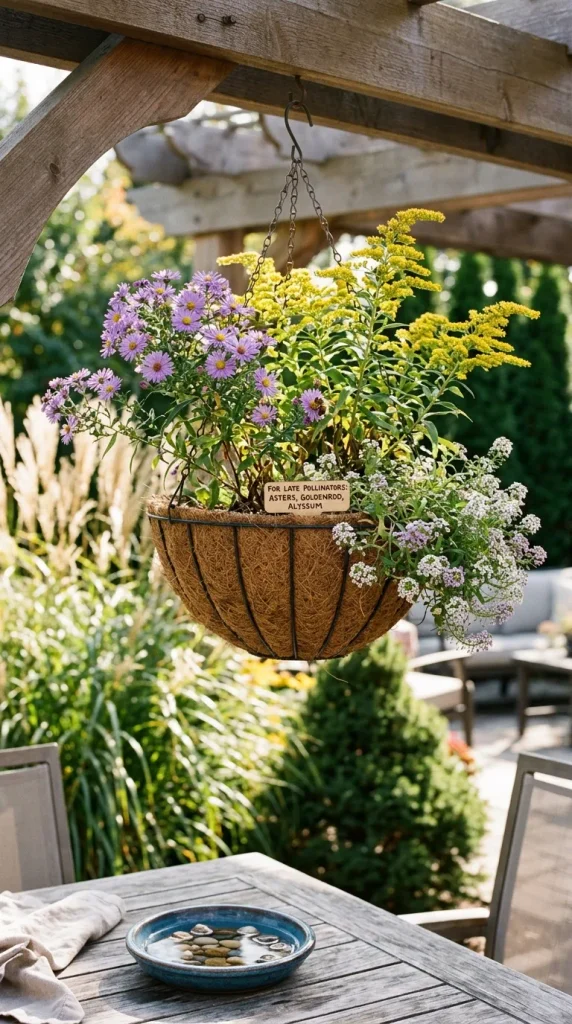
Your fall basket can serve a purpose beyond decoration.
Late-season flowers provide valuable resources for pollinators preparing for migration or overwintering. University of Minnesota Extension’s August 2026 guidance specifically highlights the importance of autumn nectar sources and recommends plants such as asters and other pollinator-friendly choices for late-season containers.
Design the basket around accessibility for insects, rather than maximum visual density.
Avoid creating a packed mass where every flower is buried behind foliage. Give flowering stems enough exposure for visiting bees and butterflies.
Place the basket somewhere sunny and visible from your seating area, and you may find that the visitors become part of the display.
Helpful pollinator-garden accessories
- A small plant label can identify the ecological purpose of the basket.
- A hanging hook with enough clearance keeps flowers accessible.
- A nearby shallow water source can complement the planting without crowding the basket.
14. A Swiss Chard Basket for Edible Color
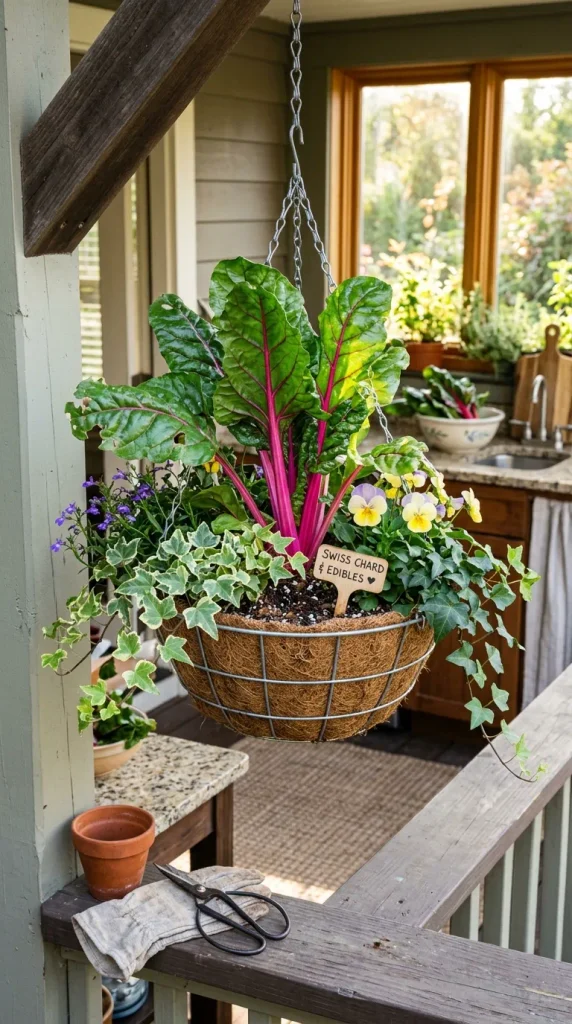
Swiss chard is an interesting choice because it does not need to look like a traditional ornamental plant to become part of a decorative basket.
Its glossy foliage and brightly colored stems can provide strong visual contrast while remaining edible. Illinois Extension specifically recommends Swiss chard as a fall container plant because of its attractive stems and foliage.
Use chard as the visual centerpiece and surround it with lower foliage or trailing plants.
This idea is especially good for people who like ornamental gardens but also want their containers to earn their space.
Just keep the basket within comfortable harvesting height.
Useful edible-garden tools
- Compact harvesting scissors make repeated cutting convenient.
- Plant labels help distinguish edible plantings from ornamental ones.
- A sturdy liner helps support frequent watering and harvesting.
15. A Shaded Porch Basket Designed for Low Light
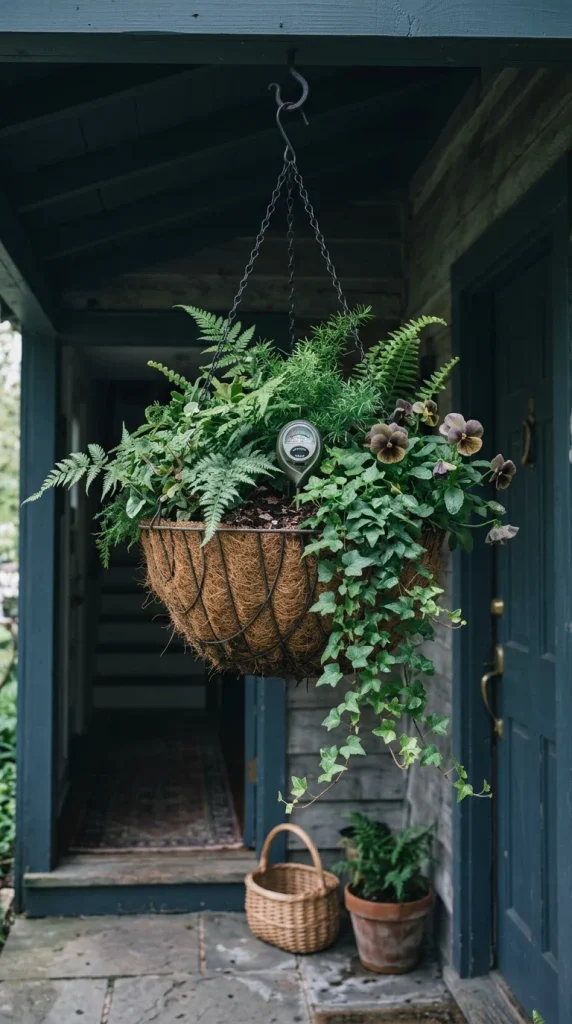
Not every fall basket belongs in full sun.
A covered porch, north-facing entry, or deeply shaded balcony changes what will perform well.
Instead of forcing a sunny fall planting into a poor location, design the basket around the light that actually exists.
Trailing and shade-tolerant plants can soften the edges, while foliage can become more important than heavy flowering.
This is a particularly useful approach because solving the site’s limitation becomes the concept itself.
Useful shade-basket accessories
- A lightweight basket makes repositioning easier when you are testing light levels.
- A moisture meter can help monitor slower-drying shaded containers.
- Adjustable hanging hardware makes seasonal repositioning simple.
16. A Repurposed Container Hanging Basket
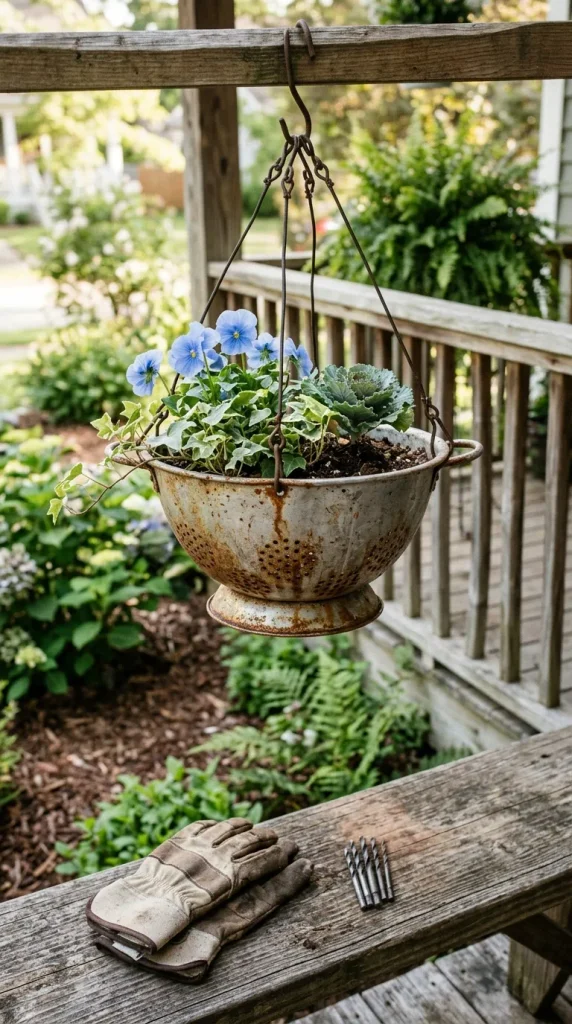
For a more relaxed garden, repurpose a suitable household or vintage container as the basket itself.
An old metal colander, weathered pail, shallow wooden container, or other structurally sound object can become an unexpected hanging planter.
The important part is adapting the container correctly. It needs adequate drainage, secure attachment points, and enough strength to support the planting after watering.
The character comes from the container rather than from adding lots of seasonal decorations.
Keep the planting relatively restrained so the reused object remains visible.
Handy upcycling supplies
- Outdoor-rated drill bits help create drainage holes in suitable containers.
- Strong wire or chain can create a secure suspension system.
- Rust-resistant hardware is worth using outdoors.
17. A Fall-to-Winter Transition Basket
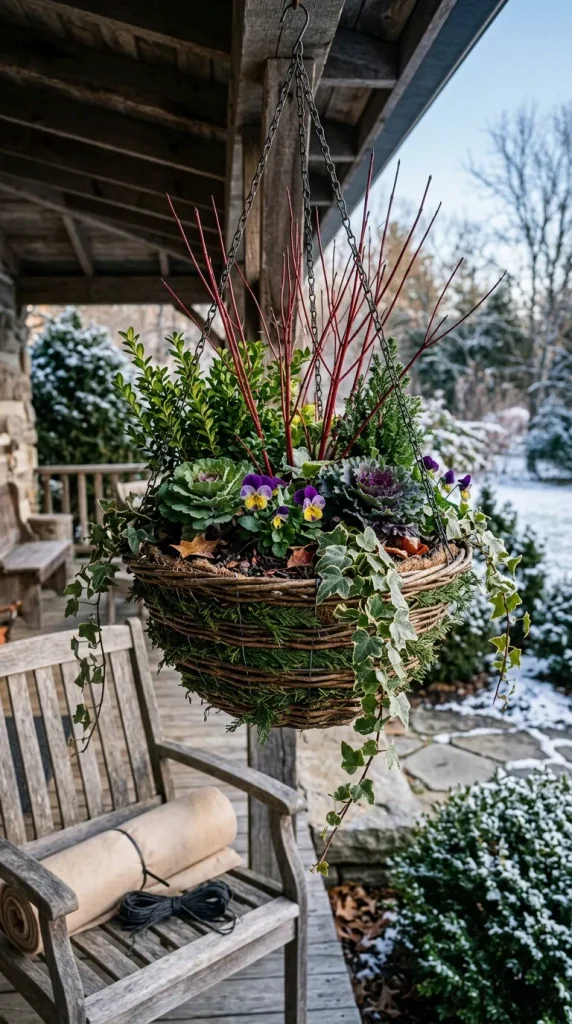
The smartest fall basket may be the one you do not have to replace in a few weeks.
Build the planting around elements that can carry visual interest from autumn into colder weather.
Evergreen foliage, woody stems, hardy trailing plants, and durable foliage can provide the backbone, while seasonal flowers add the fall layer. Illinois Extension notes that evergreen branches, woody plants, hardy trailing plants, and broadleaf evergreens can all contribute to winter container displays.
This gives you a basket that evolves instead of suddenly becoming irrelevant after the first hard frost.
You can remove declining seasonal plants while leaving the stronger structural components in place.
That makes this approach particularly appealing if you prefer low-maintenance seasonal decorating.
A few useful transition pieces
- Weather-resistant ties make it easier to replace seasonal stems.
- A durable evergreen basket liner can remain in place longer.
- Frost protection fabric can help extend vulnerable plants during cold snaps.
How to Make Fall Hanging Baskets Look Better
The best fall hanging baskets usually are not the ones with the most plants.
They are the ones where each plant has a job.
A useful starting point is to decide whether the basket needs height, fullness, movement, flowers, foliage, food, privacy, or seasonal longevity. Once that purpose is clear, plant selection becomes much easier.
Also consider where the basket will be viewed from.
Illinois Extension recommends a different planting approach for baskets near eye level compared with baskets positioned well above eye level. Eye-level baskets can use an upright center with shorter and trailing plants around the edges, while higher baskets often benefit from rounded or trailing forms that can be appreciated from below.
Watering deserves just as much attention as the planting design. Hanging baskets can dry quickly, particularly porous wire baskets, and late-season containers can still require careful moisture management. Illinois Extension recommends watering thoroughly and maintaining relatively uniform moisture rather than allowing repeated severe wilting.
And do not automatically replace every summer plant.
If something is still healthy and attractive, incorporate it into the fall arrangement. Extension guidance specifically recommends combining fall blooms or foliage with healthy existing plants, particularly structural plants such as ornamental grasses.
That small decision can make a fall basket look much more established.
Final Thoughts
The most interesting fall hanging basket ideas are not necessarily the most colorful ones.
A basket can solve a space problem on a balcony, frame a front door, provide herbs beside an outdoor kitchen, support late-season pollinators, create movement with trailing foliage, or transition quietly from autumn into winter.
That is a much better way to approach seasonal container gardening than simply asking, “Which flowers should I put in this basket?”
Start with the job you want the basket to perform. Then choose the structure, planting habits, location, and maintenance approach that support that job.
And if your first attempt looks a little sparse, don’t panic. Fall containers often need a little patience before they settle into their final shape. The goal is not to cram the basket full on day one; it is to create something that looks believable, intentional, and increasingly natural as the season progresses.

William Martin is a passionate bowler who spends most of his weekends playing the sport. With years of intense experience under his belt, William decided to share his knowledge by creating BOWLING OCEAN. Join me on this journey to explore the world of bowling and discover the tips and tricks to becoming a pro.