How to Get Rid of Weeds in Rocks and Stop Regrowth
Weeds growing through rocks can make a clean landscape bed look messy fast. The good news is that you can get rid of weeds in rocks with a few simple methods, but the best choice depends on where the weeds are growing, how many there are, and whether you have nearby plants you want to protect.
The quick answer: pull small weeds by the root, use boiling water or vinegar on young isolated weeds, and use a labeled weed killer for deep-rooted or recurring weeds. Then prevent new weeds by removing debris, fixing weak landscape fabric, maintaining enough rock depth, and using pre-emergent weed control before seeds sprout.
The key is to treat this as two separate jobs: remove the weeds you can see now, then stop new seeds from settling into the rocks later.
Why Weeds Grow in Rocks
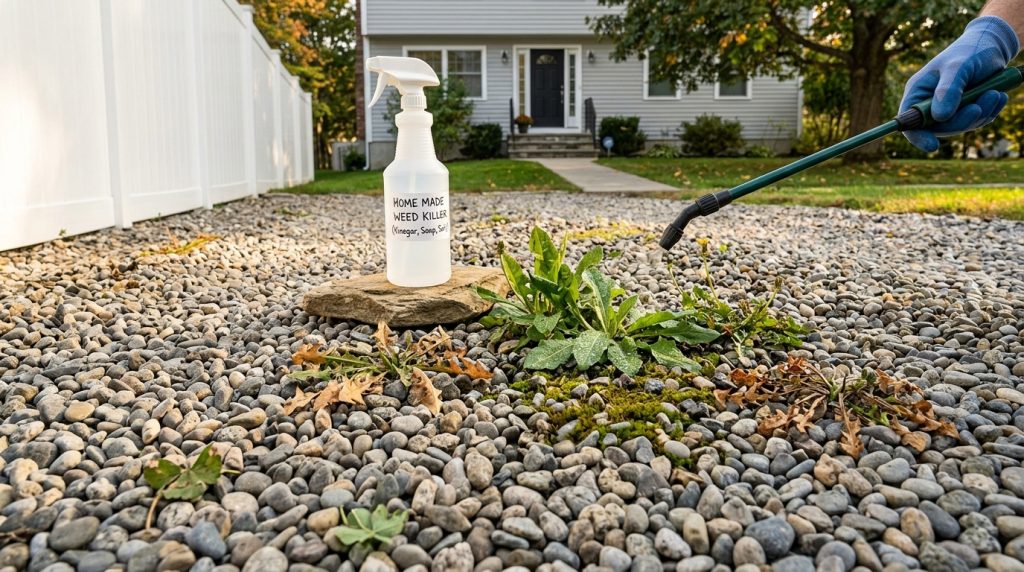
Rock landscaping is low-maintenance, not no-maintenance.
Weeds can grow in rocks because seeds blow in from lawns, trees, nearby beds, birds, mowing, and runoff. Once dust, leaves, grass clippings, and soil collect between the stones, weed seeds have just enough material to sprout.
This is why weeds can appear even when landscape fabric is already under the rocks. The fabric may block weeds from below, but it cannot stop seeds from landing on top.
Common causes include:
- Thin rock coverage
- Old or torn landscape fabric
- Dirt and leaves trapped between stones
- Grass creeping in from lawn edges
- Weed seeds blowing in from nearby areas
- Irrigation or runoff carrying soil into the rock bed
- Deep-rooted weeds that were not fully removed before installation
If your rock bed is older, the issue is usually not just “weeds coming through.” It is often weeds growing in the organic layer that has built up on top of the rock or fabric.
Best Ways to Get Rid of Weeds in Rocks
Use this table to choose the right method quickly.
| Situation | Best Method | Why It Works | Watch Out For |
|---|---|---|---|
| A few small weeds | Hand pulling | Removes the plant and root | Easier after rain or watering |
| Young weeds in open gravel | Boiling water | Burns soft growth quickly | Can splash and harm nearby plants |
| Small weeds away from plants | Vinegar spray | Dries out foliage | Usually does not kill deep roots |
| Large gravel driveway | Hoe, torch, or herbicide | Covers more area faster | Choose based on safety and nearby plants |
| Deep-rooted perennial weeds | Post-emergent herbicide | Moves into the plant system | Must follow label directions |
| Weeds keep returning | Pre-emergent + cleanup | Stops new seedlings | Does not kill existing weeds |
| Old rock bed full of debris | Refresh the rock bed | Removes the seedbed layer | More work upfront |
Step 1: Pull Small Weeds by the Root
For small patches, hand pulling is still one of the best methods.
It is simple, precise, and does not add anything to the soil. It also works especially well around desirable plants, shrubs, trees, and garden borders where sprays could cause damage.
For best results:
- Water the area lightly or weed after rain.
- Move a few rocks away from the base of the weed.
- Grab the weed low near the crown.
- Pull slowly instead of yanking.
- Remove as much root as possible.
- Replace the rocks after the root is removed.
If the weed snaps off, it may regrow. Use a weeding knife, hori hori knife, screwdriver, trowel, or hand fork to loosen the root.
This is especially important for weeds with taproots, such as dandelions, or spreading roots, such as some grasses.
Step 2: Use Boiling Water for Isolated Weeds
Boiling water is one of the simplest natural ways to kill weeds in rocks.
It works best for small weeds, young seedlings, and weeds growing in gravel paths, rock walkways, or areas away from valuable plants.
To use it:
- Boil water in a kettle.
- Wear closed-toe shoes and long pants.
- Pour slowly at the base of the weed.
- Keep the flow controlled so it does not splash.
- Repeat after a week if the weed regrows.
Boiling water damages the plant tissue quickly, but it may not fully kill deep roots. It is best for spot treatment, not large areas.
Avoid using boiling water near shallow-rooted plants, delicate shrubs, synthetic fabric, or areas where hot water could run into a garden bed.
Step 3: Try Vinegar on Young Weeds
Vinegar can work on small weeds in rocks, especially on hot, sunny days. It burns the leaves and dries out young growth.
However, vinegar is not magic. Household vinegar is usually better for small, young weeds than mature perennial weeds. It often damages the top growth without killing the entire root.
Use vinegar carefully:
- Spray only the weed leaves.
- Apply on a dry, sunny day.
- Avoid windy weather.
- Keep it away from flowers, shrubs, lawns, and vegetables.
- Expect repeat applications.
Do not treat vinegar as a harmless garden tonic. It is non-selective, which means it can damage any plant it touches.
Step 4: Be Careful With Salt
Salt is often recommended as a homemade weed killer for rocks, but it should be used very carefully.
Salt can dry out weeds, but it can also damage soil, nearby plants, tree roots, lawns, and future planting areas. Rain or irrigation can move salt beyond the spot where you applied it.
Salt may be acceptable in isolated rock areas where you never plan to grow anything, such as cracks in a gravel parking strip or a far edge of a driveway.
Avoid salt:
- Near flower beds
- Around trees or shrubs
- Beside lawns
- On slopes where runoff moves
- Near vegetable gardens
- In areas you may plant later
- Where pets may walk or lick surfaces
If you want a safer long-term landscape, use salt as a last resort, not a routine maintenance method.
Step 5: Use a Flame Weeder Only in Safe Areas
A flame weeder, also called a weed torch, can be effective on weeds in gravel and rock areas.
The goal is not to set weeds on fire. The goal is to pass heat over the weed until the leaves wilt. The heat damages the plant cells, and the weed dries out.
A flame weeder works best on:
- Gravel driveways
- Rock paths
- Open stone areas
- Young weeds
- Areas with no dry leaves or mulch nearby
Do not use a torch:
- During dry or windy weather
- Near wood mulch
- Near dry leaves
- Near fences, decks, sheds, or siding
- During fire restrictions
- Around drip irrigation tubing
- Near landscape lighting wires
- Around poisonous plants
Wear long pants, closed-toe shoes, gloves, and eye protection. Keep a hose nearby. If your area is under a burn ban or fire weather warning, skip this method.
Step 6: Use Herbicide for Stubborn or Deep-Rooted Weeds
If weeds keep returning from the same spot, you may be dealing with deep roots, rhizomes, or perennial weeds.
In that case, boiling water and vinegar may only burn the top growth. A labeled post-emergent herbicide may work better because it targets existing weeds.
There are two basic types to understand:
- Contact herbicides: Burn or damage the part of the plant they touch. These work best on small annual weeds.
- Systemic herbicides: Move through the plant and can help kill the root. These are often better for perennial weeds.
Use herbicides carefully in rock beds because most weed killers are non-selective. They can damage desirable plants if spray drifts or runs off.
Basic safety rules:
- Read and follow the label.
- Use only on listed areas.
- Wear the recommended protection.
- Avoid windy days.
- Shield nearby plants with cardboard.
- Keep pets and children away until the label says it is safe.
- Do not overspray into drains, ponds, lawns, or garden beds.
A small amount applied carefully is usually better than soaking the entire rock bed.
Step 7: Clean the Rocks So Seeds Have Nowhere to Grow
Many weeds in rocks are not growing from deep soil. They are growing from dirt and organic debris trapped between stones.
That means prevention starts with cleaning.
Use a leaf blower, broom, or shop vacuum to remove:
- Leaves
- Grass clippings
- Dust
- Seed heads
- Loose soil
- Dead weeds
- Mulch pieces
- Tree debris
This matters because decomposing debris turns into a thin growing layer. Once that layer forms, weed seeds can sprout even above landscape fabric.
For rock beds near lawns, blow grass clippings away after mowing. For rock beds under trees, clean them more often during leaf drop.
Step 8: Maintain the Right Rock Depth
A thin rock layer lets sunlight reach the soil and gives weed seeds an easier place to root.
As a general rule, decorative rock should be deep enough to block light and stay in place, but not so deep that it buries plant crowns or traps excessive heat around shrubs.
For many rock beds, a depth of about 2 to 4 inches works well, depending on the rock size and location.
Small gravel may need a slightly different depth than large river rock. Larger rocks leave bigger gaps, so seeds and debris may collect more easily. Smaller gravel compacts more tightly but can also trap fine soil over time.
If you can see fabric, bare soil, or thin patches, add more rock after removing weeds and debris.
Step 9: Fix or Replace Old Landscape Fabric
Landscape fabric can help under rocks, especially in paths and decorative beds. But it does not last forever.
Over time, fabric can tear, shift, clog, or collect dirt on top. Weeds may root into the debris above the fabric or grow through weak spots.
Signs your fabric needs attention:
- Weeds appear in the same lines or seams.
- Rocks sink into the soil.
- Fabric is visible and fraying.
- Water pools instead of soaking through.
- Weeds pull up with pieces of fabric attached.
- Soil and leaves have formed a layer above the fabric.
For a small area, move the rocks aside, remove weeds and debris, patch the fabric, overlap seams, pin it down, and replace the rock.
For a badly overgrown bed, the best fix may be a full refresh: remove rocks, clear weeds, repair or replace the barrier, and reinstall clean rock at the right depth.
Step 10: Use Pre-Emergent Weed Control for Prevention
Pre-emergent weed control does not kill existing weeds. It helps stop new weed seedlings from establishing.
This is useful in rock beds because most new weeds start from seeds that blow or wash into the rocks.
Use pre-emergent after existing weeds are removed and before new seeds sprout.
Common timing:
- Early spring for warm-season weeds
- Late summer or early fall for cool-season weeds
Always follow the product label. Some pre-emergents can affect desirable seeds, so do not use them where you plan to direct-sow flowers, groundcovers, or other plants.
Natural vs Chemical Weed Control in Rocks
Both natural and chemical methods can be useful. The best choice depends on your goal.
| Method | Natural? | Best For | Main Limitation |
| Hand pulling | Yes | Small patches and planted beds | Labor-intensive |
| Boiling water | Yes | Isolated young weeds | May not kill deep roots |
| Vinegar | Yes | Small young weeds | Can damage nearby plants |
| Salt | Yes, but risky | Isolated non-planted areas | Can damage soil long-term |
| Flame weeder | Chemical-free | Gravel paths and driveways | Fire risk |
| Post-emergent herbicide | No | Existing stubborn weeds | Must be used carefully |
| Pre-emergent herbicide | No | Preventing seedlings | Does not kill existing weeds |
| Rock bed refresh | Chemical-free | Old, dirty, overgrown rock beds | More work upfront |
Common Mistakes to Avoid
| Mistake | Why It Causes Problems | Better Fix |
| Spraying everything without identifying the weed | Some weeds regrow from roots | Pull or treat based on weed type |
| Using salt near plants | Salt can move into nearby soil | Reserve salt for isolated hardscape areas |
| Expecting vinegar to kill deep roots | Vinegar mostly burns foliage | Use root removal or systemic control for perennials |
| Ignoring leaf debris | Debris becomes a seedbed | Blow or sweep rocks regularly |
| Adding more rock over weeds | Weeds may keep growing underneath | Remove weeds first |
| Using torn fabric as-is | Weeds grow through gaps | Patch or replace fabric |
| Applying pre-emergent over mature weeds | It will not kill existing plants | Remove weeds first, then apply |
| Pressure washing too aggressively | Can move gravel or expose fabric | Use controlled cleaning methods |
How to Stop Weeds from Coming Back in Rocks
The best long-term solution is a simple maintenance system.
Weekly or Biweekly
- Pull tiny weeds before they seed.
- Blow out leaves and grass clippings.
- Check lawn edges for creeping grass.
Monthly
- Inspect fabric seams and thin rock spots.
- Remove dead weeds after treatment.
- Rake rocks lightly to even out low areas.
Seasonally
- Apply pre-emergent if appropriate.
- Refresh rock depth where needed.
- Trim plants so they do not drop excess debris.
- Re-edge the border between lawn and rock.
Every Few Years
- Remove built-up soil and organic matter.
- Repair or replace landscape fabric.
- Add fresh rock where the layer has thinned.
- Rework drainage if runoff keeps carrying soil into the bed.
This is what keeps rock landscaping low-maintenance. It is not one dramatic treatment. It is small upkeep before weeds mature.
What If Weeds Keep Coming Back?
If weeds return quickly, look for the cause instead of repeating the same treatment.
Possible reasons:
- You are only killing leaves, not roots.
- The rock layer is too thin.
- Soil has built up between stones.
- Landscape fabric is torn or clogged.
- Grass is creeping in from the lawn.
- Nearby weeds are dropping seeds.
- Water runoff is carrying soil into the rocks.
- You are applying pre-emergent too late.
A heavily overgrown rock bed may need more than spray. Sometimes the right solution is to remove the rock, clear the soil, repair the barrier, install edging, and reset the bed properly.
Best Method for Different Rock Areas
Rock Beds Around Shrubs
Use hand pulling, careful spot spraying, and debris cleanup. Avoid salt and broad spraying. Protect leaves and bark from any herbicide drift.
Gravel Driveways
For large open areas, a hoe, flame weeder, or labeled herbicide may be more realistic. Pre-emergent can help reduce new seedlings after existing weeds are controlled.
Decorative River Rock
Remove debris often because large rocks trap leaves and soil. Pull weeds early before roots weave around the stones.
Rock Borders Along Lawns
Install or repair edging. Many “weeds” in rock borders are actually grass spreading sideways.
Rock Walkways
Hand pulling, boiling water, or flame weeding can work well. Keep the walkway swept so seeds do not settle.
FAQ Section
What is the fastest way to get rid of weeds in rocks?
The fastest method depends on the area. For a few weeds, pull them by the root. For young weeds in open rocks, boiling water can work quickly. For stubborn recurring weeds, a labeled post-emergent herbicide may be faster and more complete. Always protect nearby plants from heat, spray, or runoff.
How do I permanently stop weeds from growing in rocks?
You cannot truly stop all weeds permanently because new seeds can blow into the rocks. The best long-term control is removing existing weeds, cleaning out debris, maintaining enough rock depth, repairing landscape fabric, edging lawn borders, and applying pre-emergent at the right time before seeds sprout.
Does vinegar kill weeds in rock beds?
Vinegar can kill small young weeds by burning their leaves, especially on sunny days. It is less reliable on large weeds or deep-rooted perennials because it may not kill the roots. Use vinegar carefully because it can damage flowers, shrubs, grass, and other desirable plants it touches.
Is salt good for killing weeds in rocks?
Salt can kill weeds, but it can also damage soil and nearby plants. It may move with rain or irrigation and affect areas beyond the spot you treated. Avoid salt near lawns, trees, shrubs, flower beds, vegetable gardens, and any place you may want to plant later.
Should I put landscape fabric under rocks?
Landscape fabric can help under rocks, especially in pathways and decorative beds. It blocks weeds from below while still allowing some water and air movement. However, it is not permanent. Dirt and debris can collect on top of the fabric, allowing weeds to grow above it over time.
Why are weeds growing through my rocks even with fabric?
The weeds may not be coming from under the fabric. They may be sprouting in soil, dust, leaves, and organic matter that collected on top of the fabric. Fabric can also tear, shift, or clog over time. Cleaning the rock bed and repairing weak spots can reduce regrowth.
Can I use boiling water to kill weeds in rocks?
Yes, boiling water can kill young weeds in rocks, gravel, and hardscape areas. It works best on isolated weeds and small patches. Be careful because it can splash, burn skin, damage nearby plants, and possibly affect synthetic fabric. It may need repeated applications for deep-rooted weeds.
What is the best weed killer for rocks?
The best weed killer for rocks depends on the weed. Young annual weeds may respond to boiling water or vinegar. Deep-rooted perennial weeds usually need root removal or a labeled systemic herbicide. For prevention, pre-emergent weed control can help stop new seedlings after existing weeds are removed.
Conclusion
The best way to get rid of weeds in rocks is to combine removal and prevention.
Pull small weeds by the root. Use boiling water or vinegar for young isolated weeds. Use a labeled herbicide only when the weeds are stubborn, deep-rooted, or too widespread for manual removal.
Then focus on the real long-term fix: keep debris out of the rocks, maintain the right rock depth, repair landscape fabric, edge the lawn, and stop weeds before they go to seed.
Rock landscaping will never be completely maintenance-free, but with the right system, it can stay clean, tidy, and much easier to manage.

William Martin is a passionate bowler who spends most of his weekends playing the sport. With years of intense experience under his belt, William decided to share his knowledge by creating BOWLING OCEAN. Join me on this journey to explore the world of bowling and discover the tips and tricks to becoming a pro.